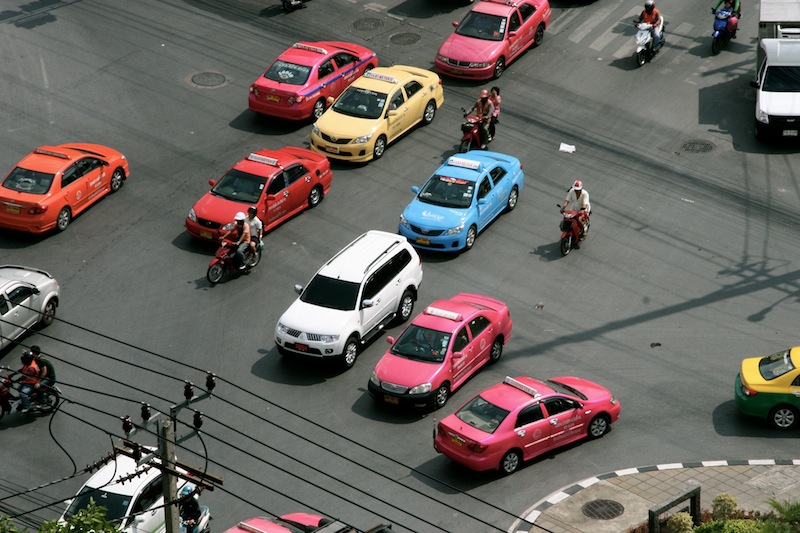

“What’s the word in English for beua?” asked the taxi driver who didn’t want to be named because the cab wasn’t his. It’s his brother’s, he confessed. His brother was sick, so he took the cab out to earn a couple of extra bucks.
“Bored,” the driver said, getting acquainted with the English translation and understanding fully what it meant. Kaset-Nawamin Road leading to the suburbs was packed to such a halt that you’d have time to get out for a stretch.
That particular cab ride was un-metered. The driver explained that he wouldn’t have picked me up otherwise because: 1) It’s a hassle getting back to the city because of traffic and 2) he’d be burning precious natural gas for vehicles (NGV) for nothing. Prices for NGV were set to raise in 0.50 baht increments every month from January to December this year, but the National Energy Policy Council (NEPC) just instituted a three-month freeze until August 15, The Bangkok Post reported.
But the THB500 million per month government subsidy – the one that has kept NGV prices low for so long – may run out soon, as experts are calling to let prices float. The Siam Taxi Co-operative thinks that if the government can’t hold off the natural gas costs that fares should increase.
In late March, co-op president Witoon Naewpanich demanded that the following fare changes take effect:
-Short distance fares (under 50km) will rise 12%. So a ride from Ekkamai to Ratchada MRT Station ( about 11km) would rise roughly from THB87 to THB97.50 baht, assuming there is no traffic (yea right).
-Long distance fares (from 50 to 100 km) will raise 8%.
-The stand-still rate for a non-moving taxi on the job will almost double from THB1.50 to THB2.50 baht a minute.
The Transportation Ministry agreed with the cooperative that taxi fares need to be updated, but Transport Minister Advisor Chinnawat Haboonpard said the decline in taxi operator wages has more to do with the the amount of taxis on the road than the rising cost of living. He said Bangkok really needs only 35,000 taxis out of the 100,000 on the road.
Witoon agreed that less taxis should be on the road, saying that 50,000-60,000 would be an appropriate amount. Nonetheless, he said that the taxi co-op would take actions to pressure the government on a fare increase if the Transport Ministry doesn’t respond to their demands.
Because of the NGV price freeze enacted yesterday, taxi fares will remain static for the moment.
The Driver’s Side
Is there a real urgency to increase fares, as Witoon demands? Taxi driver Panonnakorn Kornpit didn’t think so.
“Right now, with the NGV price where it’s at, things are OK,” Panonnakorn said. “During the low season, it’s a little bit hard, but I get by.” But if NGV ever goes up to THB13 per kilo, he said a fare hike will be needed.
He said it costs him THB400 for gas and THB600 to rent a taxi for 24 hours. There are no constants in his line of work, he said. “Sometimes you make THB2000 in a day or even more, sometimes you barely make enough to pay the gas and car rental fees.”
But he said his go-to move is to takes daily trips to Suvarnabhumi airport, sometimes four or five. The hourly waits are the downside. He said up to 7,000 taxis pass through Suvarnabhumi daily.
The upside is he doesn’t waste gas going into suburbs, he doesn’t have to hustle for customers the way he has to in the city, and he can avoid the dangers that come with it. He said he was strangled from behind and was once mugged. Working in the city is rough, he said, and that’s why he refrains from it unless he has to.
Panonnakorn said that if the taxi fare doesn’t raise when NGV hits THB13/kilo, he’d be better off doing something else with a constant salary because there are too many taxis on the road anyway.
The Passenger’s Side
The average Bangkokian knows the following scenarios all too well: being jammed in the BTS or MRT, battling a horde of people for a taxi, getting snaked by passengers who move up the road, getting your hopes up as the taxi rejects the person ahead, watching the taxi whoosh by as you get rejected too. It’s like BED Supperclub’s model’s night all over again.
“Taxi drivers here can be summed up with one word: snobs,” daily taxi commuter Baraq Stein gripes. “I live far away and people don’t like to drive there because they say it’s too far and there are no customers to pick up.”
Co-op president Witoon said the increase would give more incentive for taxi operators to pick up customers going longer distances. But how will this be ensured? Will Bangkok taxi-goers continue to get the raw treatment?
Besides the usual complaints about a driver’s lack of personal hygiene or radio etiquette, or being rejected a ride or metered fare, sometimes things can get dangerous for a passenger.
It happened last year during Songkran to a man whose nickname is Paris. He prefers to keep his real name confidential.
“I was about to catch a cab to Sathorn, and suddenly the taxi driver made a surprise U-turn to Soi Saladaeng. I started to realize something was wrong,” said Paris.
When he confronted the taxi driver, he turned around with a pistol. Before Paris knew it, he was staring down a barrel of a gun.
“I was so shocked I didn’t even look closely to see if the gun was real or not,” Paris said. “The taxi driver turned to me and said, ‘Give me your mobile and money.’ I could do nothing but do as he said because all I knew was to get off the cab safely.”
Though Paris hasn’t heard of anyone else experiencing a something like this, he learned his lesson. Now he makes a note of the registration numbers and driver names of every taxi he takes.
“It happened to me in the center of the town. It could happen to [anyone],” said Paris. “There are many good drivers too, so you just have to be careful.”
The Bottom Line
20,000 of the 100,000 taxis on the road in Bangkok are un-registered, meaning less accountability and more potential danger for passengers. Fares will inevitably rise as Thailand’s economy grows stronger, but regulation should increase as well. At least some of those un-needed cabs clogging up the streets should be done away with, hopefully in a way that helps their drivers find alternative employment.
We sympathize with the plight of the taxi driver, but we also understand that NGV has been subsidized for way too long. Similar actions by Greece has put then into the financial full-nelson they are in now.
Ultimately, Bangkokians just want to be able to get from point A to point B in taxi quicker and with less hassle, and I think a majority would be willing to pay a small percentage more to improve the system….
Can someone please make this happen?