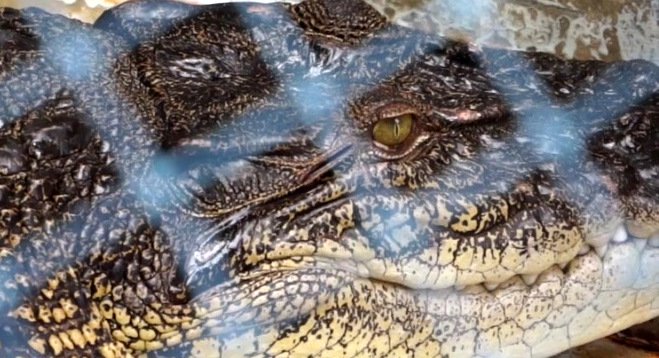

Animal rights advocates are calling for authorities to provide a natural reserve for the beach croc caught on Phuket’s west coast last week.
The reptile, dubbed “Leypang” after the area where he was found, seems depressed since being detained after appearing playful when he was free. Advocates are beomcing worried about him being provided appropriate care.
Leypang was caught early Friday morning and is being kept at a Phuket Coastal Fisheries Research and Development Center in Phuket.
Immediately after the 200-kilo, three-meter saltwater croc’s capture, Phuket Gov. Norraphat Plodthong ordered officials along the west coast to look for other crocodiles in their areas to ensure public safety.
Local crocodile farms and tourist show venues were also checked to confirm no crocodiles were missing.
To date, no others have been found. To experts, that is not surprising. Saltwater crocodiles for decades have been widely considered to be near extinct in Thailand, and any rogues that are found in Thai waters are protected as they are listed as an endangered species in the country.
Dr. Thon Thamrongnawasawat, Deputy Dean of the Faculty of Fishery at Kasetsart University in Bangkok, who serves as an official advisor to the Department of Marine and Coastal Resources (DMCR), urged officials to take proactive steps to ensure Leypang is properly cared for – but most importantly he stressed that whatever decision is made, that local residents support it.
“I know that many people are calling for Leypang to be set free, but this should only happen if there is overwhelming support for it among local residents,” he said, noting that local residents are the ones who would have to live with the crocodile in their midst.
“Officials should exhaust all possibilities of tracking down where Leypang came from and return him to the wild there. I know officials are working hard on this, but if that option is not possible, whatever option is decided must include the opinions of local people – and whichever agency is tasked with making the decision must not be held responsible for the decision alone, everyone affected must have their say on this,” Dr. Thon said.
Meanwhile, well-known conservationists in Thailand the Sueb Nakhasathien Foundation (SNF) called for Leypang to be moved immediately to a “closed suitable natural place for study and to relieve the crocodile of stress.”
The stress, SNF noted, was evident in that Leypang seemed despondent and was not eating while in his current enclosure.
As a long-term measure, SNF called for Leypang to be released in a suitable habitat for survival.
Story: The Phuket News