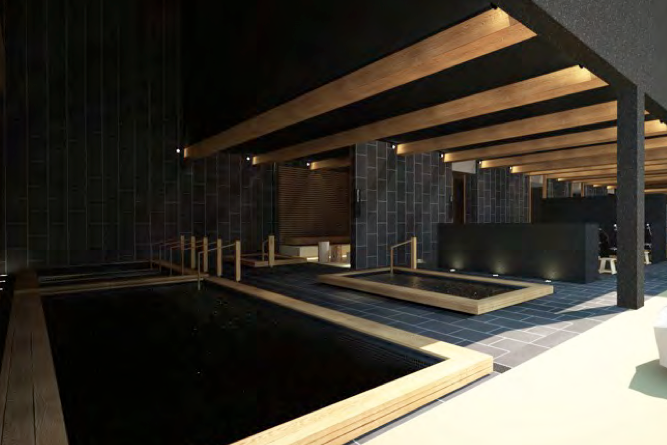

What is now a giant pile of concrete, pine, teak and tile at the back of the A-Squared project on Sukhumvit 26 is about to become something you should know about, especially if you A) are Japanese, B) interested in building relationships while naked, or C) love eating Japanese and organic food.
So what kind of place caters to all these interests?
“The concept is nothing new, its lifted straight from Japan, but there is nothing else like it here in Bangkok,” says Smith Mekaroonkamol, the man behind the Yunomori Super Sento, a sizable Japanese lifestyle retreat featuring numerous forms of onsen baths. “There are really no places in Bangkok for the whole Japanese family to go. Husbands will go golfing, wives will go shopping—but we wanted a place for the whole family to enjoy.”
[[{“type”:”media”,”view_mode”:”media_original”,”fid”:”16945″,”attributes”:{“alt”:””,”class”:”media-image”,”height”:”315″,”typeof”:”foaf:Image”,”width”:”486″}}]]
An onsen is a traditional Japanese communal bathhouse where bathwater is drawn from mineral-rich hot springs. Japanese believe bathing naked in these spring water baths cures ailments, diseases and even offers a solution for constipation. There are many kinds of onsen, and they all use different minerals or additives in the bathwater. Sulfur onsens are most popular, while options such as iron onsens and sodium-chloride onsens do exist.
Set to open in late August, Yunomori Super Sento takes the onsen experience a step further; it offers guests a wide variety of spa treatments, a small bar offering Japanese brews, two restaurants, and traditional Japanese gardens. Even if you’re not into the whole bath experience, the restaurants, Gastro 1/6 and Torajiro Izakaya, should be worth the trip.
Yunomori directly translates to “hot bath forest,” a name which pays homage to both the traditional gardens and onsen baths on the premises. Aside from the name, this establishment stays true to the Japanese theme by employing authentic Japanese architecture: plenty of divisions, grids, and pinewood that has been flown in from Australia (Thai pine is considered inferior).
[[{“type”:”media”,”view_mode”:”media_original”,”fid”:”16946″,”attributes”:{“alt”:””,”class”:”media-image”,”height”:”464″,”typeof”:”foaf:Image”,”width”:”580″}}]]
Access to the onsen is expected to be approximately THB450 per visit, and will allow customers to come and go as they please for an entire day. And an entire day might be needed, as there will be a slew of different onsens to try. The “soda bath” uses water infused with CO2 to help stimulate oxygen production in the body, and the main onsen uses mineral water sourced from Ranong province. Even though the concept was lifted from Japan, there is of course a Thai touch— a teakwood “Thai herbal bath” that fuses Thai aromatherapy tradition with the onsen idea to create a herbal healing bath.
“There are no bathing suits allowed. Besides, in Japanese culture, stronger relationships are formed when you’re naked. Its like you have nothing to hide.” Smith hopes that Thai patrons take to the Japanese idea and overcome their shyness to enjoy the wonderful experience of bathing naked.
Apart form the onsen, foodies are in for a real treat, as one of the two restaurants on the premises, called Gastro 1/6 is riding the wave of Bangkok’s growing gastronomic scene. The man behind the operation is none other than Bo.Lan’s Dylan Jones, so it’s no surprise that Gastro 1/6 will use locally sourced ingredients and work around the “eat responsibly” principle. Dylan is known for producing some of Bangkok’s most wholesome organic Thai food, but Gastro will be serving up artisanal western dishes with an Asian flair. The eatery also is associated with the RMA Institute, a renowned art gallery located in Bangkok, so expect to be dining in an artistic environment.
While Gastro 1/6 caters to the slow-food lovers, the more pedestrian Torajiro Izakaya, is sure to fire up the Japanese salarymen with its isakaya formula of drinking and dining. Patrons will order a wide variety of small plates of sushi, saba, grilled beef skewers, tempura and other tasty treats that go along with a generous portion of Japanese Ale.
With over 100,000 Japanese residing in Bangkok, it’s a surprise we haven’t seen another onsen here—but we hope that Yunomori kicks off this trend.
[[{“type”:”media”,”view_mode”:”media_original”,”fid”:”16947″,”attributes”:{“alt”:””,”class”:”media-image”,”height”:”284″,”typeof”:”foaf:Image”,”width”:”498″}}]]










