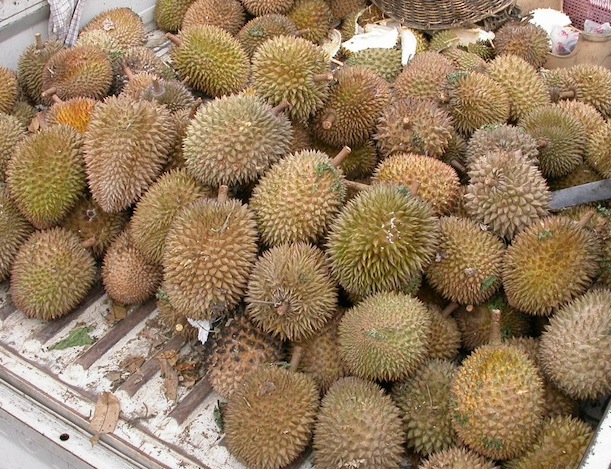

Fans of the spiky and creamy fruit are in disagreement as to whether the new and improved “stink-free” durian should be supported and released in the Thai market.
Dr. Songpol Somsri, a renowned fruit breeder from the Horticulture Research Institute, announced recently that he is close to putting the genetically-enhanced version of the durian fruit out on the market. It took Dr. Songpol 25 years of extensive research to come up with this non-stinky variant.
Over 90 varieties of the durian fruit had been studied, selected and inter-bred to come up with this variety, dubbed as Chantaburi No. 1. A fourth, fifth and sixth variant has been released in 2012, and the good doctor promised more to come.
He was quick to assure critics however that the new variety of durian will do little damage to the existing market for the malodorous fruit. Dr. Songpol noted that the non-stinky durian will in fact create a new market – particularly with foreigners who can not stand the smell of the otherwise delicious fruit.
The new durian variety will also be a solution to the issue of transporting the fruit inside aircraft and other public vehicles. There is currently a ban against durian by major airlines, which makes it difficult for farmers to export their produce to nearby countries.
Purists on the other hand are vehemently opposing the move, saying the smell is what gives the durian fruit its character.
“If you remove the smell of the durian just because some people don’t like it, you also remove the fun and the excitement,” said durian aficionado Joel Real of the Philippines in an NPR report. Real is set to launch his Amrita Winery and is planning to sell his durian wine creation to the US.
He maintains that the smell of the fruit works hand in hand with its flavor. Real noted that the durian loses its potency once stripped off its trademark scent.
Songpol for his part says that he has sold some 20,000 sapling trees of the Chantaburi durian variety . This means that farmers around Thailand will be harvesting sizable crops by 2013 or 2014.