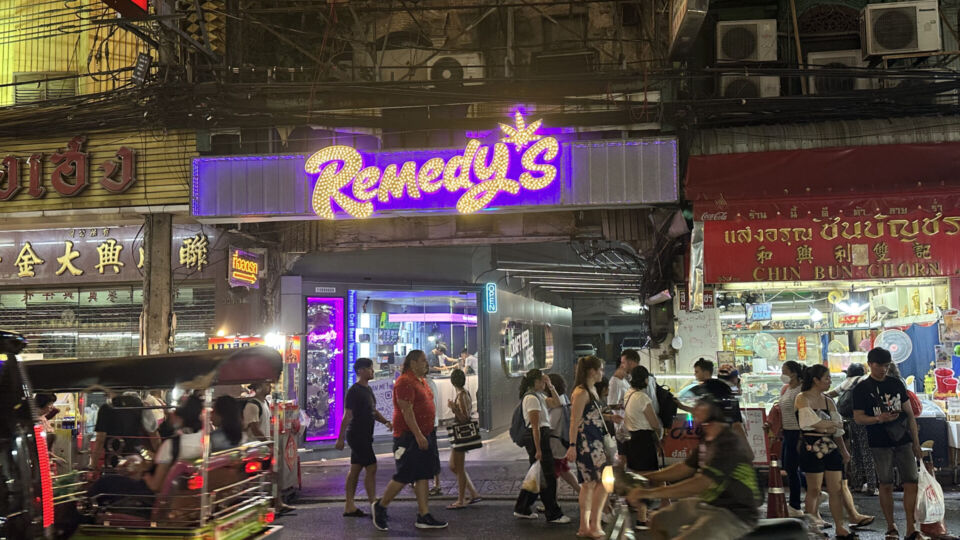

Next to the Shanghai Mansion hotel, where people listen to loud Ed Sheeran covers at one end of busy Yaowarat Road, a much quieter alley leads to two weed shops illuminated by Chinese lanterns. From one called Danq, blazed tourists walk out after smoking joints and playing video games.

Back on Yaowarat, a new dispensary called Remedy’s looks out of place between a dilapidated gold shop and neighborhood ice-cream spot. Passing tourists marvel at the garish purple glow marking it as a foreign anomaly in slow-to-change Chinatown. A group of Chinese travelers barreling by stops to take a look and, after a pause, enters.
These recently opened shops are the exception, however. Thailand’s booming weed culture hasn’t hit Chinatown like it has other neighborhoods. But doors are beginning to open now to capitalize on the recent return of Chinese tourists. How does its culturally conservative, older residents feel about this? Surprisingly receptive.
“It’s the modern fashion trend these days. It’s a normal thing to open a dispensary,” said Wareerat, a middle-aged woman who’s been selling snacks across the street for over a decade. Despite her years, she welcomes the cannabis invasion.
“You need to understand that there are many tourists coming to Yaowarat, so it’s not out of the ordinary for there to be many dispensaries now,” she said. “I’m not anti-weed, I’m accepting of such things. Many people in the neighborhood don’t really mind it.”

Only about six dispensaries could be found tucked in small sois off the busiest 1.5 kilometers or so of Yaowarat, Chinatown’s arterial road. All opened in recent months, compared to other busy parts of town that have become clogged with storefronts since last June.
Their arrival corresponds with the return, en masse, of Chinese tourists after Beijing lifted travel restrictions in January. As of the end of March, about half a million Chinese visitors had arrived.
Pongchai Khenchai, a police officer patrolling the neighborhood, isn’t really buying the whole weed thing. “I’m not sure if this is all legal,” he said.
While some of his colleagues posed for tourists’ photos in front of nearby dispensaries, Pongchai didn’t acknowledge their existence.
“I’ve never seen any dispensaries around Yaowarat,” he said with authority. “I still don’t know what the law is, or what the government wants.”
Five-hundred meters from the reality-denying Pongchai, the Greenhead Dispensary recently opened. It was the chain’s third shop in Bangkok.

“They’re just starting to pop up,” budtender Oh said as Chinese tourists stepped inside.
“Walk down some of the sois and you will see that other dispensaries have started business here too.”
In fact, almost all of the customers patronizing the new dispensaries appeared to be from China.
A Chinese traveler in his 30s, who identified himself as Joe, said that the only weed readily available in China was very low quality – and potency. He is visiting Thailand specifically to try out as many strains as he could handle.
“The weed we can get in China is only 10% THC,” he said, noting the strains with twice that or more on sale in Bangkok.
Aop, a vendor roasting chestnuts near Remedy’s, expects more shops to appear.
“I’m quite indifferent to all these dispensaries opening up as I don’t smoke,” he said. “I don’t see anyone complaining about it either. More dispensaries are going to open as time goes on.”
His attitude was not unique. Several other shop owners, who like many in this insular neighborhood declined to give their full names, said they were not worried about ganja harming the character of Chinatown, a neighborhood where not much has changed for decades.
The neighborhood’s influential Gold Traders Association could not be reached for comment.
Wu, however, has mixed feelings. The lifelong resident of 48 years works at his family snack shop just down from Greenhead. He said that while some neighborhood elders don’t approve of weed’s entry, they won’t take action so long as it’s legal.
“Nobody wants to go and file complaints because it’s legal; it’s acceptable now,” he said. “But I suppose the only thing they can do is tell their young to be careful about smoking.”
Some of the seniors are old enough to put things into their historical context.
“They would tell me that 60 years ago, people smoked opium openly,” he said. “So I suppose there isn’t much difference between opium back then and weed now.”
And catering to tourists is nothing new for the community. Wu is convinced that the recent surge of visitors – he’s noticed a two-fold increase – is due to the advent of dispensaries.
As for his own curiosity to take a puff, Wu is apprehensive: “I’m afraid whether I would get addicted to it at my age.”
While he cautiously accepts the weed boom, he still holds conservative views about what its long-term corrosive potential could be.
“Look at Din Daeng, where kratom is readily available,” he said with a certain contempt.