
In the Philippines, if you hear the word carabao, you’ll usually see traces of respect and strength in a Filipino’s eyes – it’s the country’s national animal.
But here in Thailand, if someone says kwai, you better hope they’re not talking about you.
Both terms are translations for the word “water buffalo,” to which each society has attached totally different connotations. In Thai, kwai is equivalent to “stupid,” even though the animal itself is an intelligent and hardworking part of Thailand’s agricultural livelihood.
The beloved but misrepresented animal is the subject of artist Maitree Siriboon’s solo exhibition “Buffalo’s Heart.” He explores the animal’s historical and cultural significance – both in the past and present – through a series of photographs and colored glass mosaics.
In one photograph, a young schoolboy sits above an albino buffalo, sweat glistening on his forehead as his flip-flop dangles off his foot. He clutches a Macbook – a stark contrast to the Isaan-region field in which he is framed.
[[{“type”:”media”,”view_mode”:”media_original”,”fid”:”15284″,”attributes”:{“alt”:””,”class”:”media-image”,”height”:”450″,”style”:”display: block; margin-left: auto; margin-right: auto;”,”typeof”:”foaf:Image”,”width”:”600″}}]]
In another photograph, an albino buffalo with black markings stares at the camera. This photo features a rural setting similar to that surrounding the Macbook-clutching child – an abandoned field, reeds growing high. And yet, there’s something distinctly “off” about this buffalo.
Indeed, Maitree has painted the albino buffalo to resemble a panda – a certain popular Chinese panda that resides in Chiang Mai’s zoo and attracts much more attention than the buffaloes tiring away nearby in Thailand’s rice fields. In this piece, Maitree attempts to bring the same sort of adoration and tribute to the buffalo that the celebrity panda Lin Ping receives on a daily basis.
You can see why; the water buffalo is actually kind of charming. Upon closer inspection of one photograph, I see the buffalo’s wide body is coated in peachfuzz, his eyes are soft; he stands patiently as a little boy sits upon his back.
For this exhibition, Maitree called on his childhood memories of growing up with the gentle beasts in the rural Isaan region.
The animal is part of his roots and identity. It makes sense that the contrasting set of attitudes toward the animal is the focus behind the exhibition.
“Today however, we hardly see buffaloes working in the rice fields, and yet they remain one of the most respected animals in Thailand,” said Maitree of the exhibition. “Their numbers are decreasing rapidly, and they now have assumed new roles as a decorative item, a family pet, a source of food and as a cultural icon for tourism purposes.”
I’m surprised when Jorn Middelborg, Thavibu Gallery’s Managing Director, tells me Maitree is only 30-years-old. The young artist graduated from Silpakorn University and has already been showcased internationally. His past exhibitions have included self-portraits of the blond-haired artist lying barely clothed in various scenes.
[[{“type”:”media”,”view_mode”:”media_original”,”fid”:”15285″,”attributes”:{“alt”:””,”class”:”media-image”,”height”:”450″,”style”:”display: block; margin-left: auto; margin-right: auto;”,”typeof”:”foaf:Image”,”width”:”600″}}]]
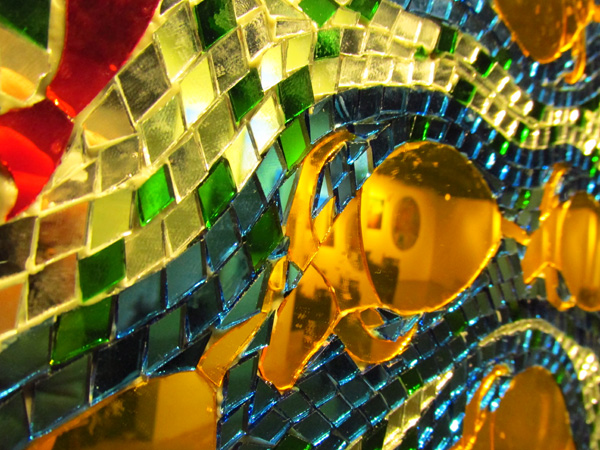
While it’s his photographs that steal the show in this exhibition, Maitree’s reflective, multi-colored glass mosaics, which depict the life of the buffalo in the abstract, still deserve attention in their own right. If you look closely, you’ll find that each piece of colored glass making up these mosaics is individually cut and delicately glued.
“It takes two to three months to create the larger pieces,” says Middelborg. “About one month for the smaller, heart-shaped pieces.”
The variations of Maitree’s heart-shaped mosaics – with red, blue and gold buffaloes swirling within – reflect your image back at you, in the centers of dozens of buffalo. You’re mirrored in the buffalo, lending the mosaic’s title, “Buffalo’s Heart,” another meaning.
The most important meaning, perhaps, is the one that the artist intended: The buffalo should be a symbol of respect and affection, meant to evoke feelings of pride, rather than a negative symbol and an insult. At a minimum, watch your “kwai.”
“Buffalo’s Heart,” is on display at Thavibu Gallery in Silom, but get their quick – the exhibition ends July 13.
FIND IT:
“Buffalo’s Heart” Solo Exhibition by Maitree Siriboon
Thavibu Gallery
Silom Galleria, Suite 433
919/1 Soi 19 Silom Road
BTS Surasak
02 266 5454
June 15 to July 13
Open Monday – Saturday, 11am to 7pm
Photos: Sarah Cuiska