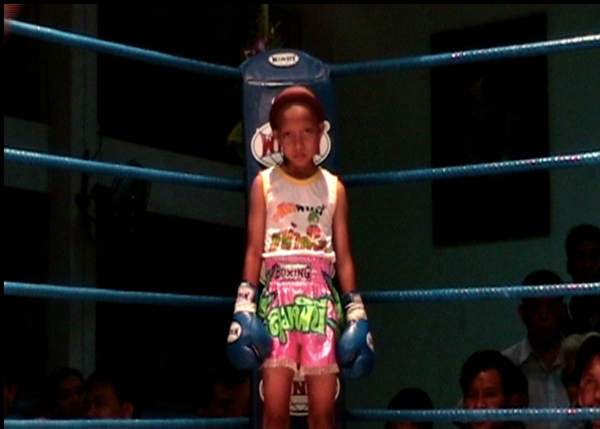

Filmmaker Todd Kellstein stumbled across child Muay Thai boxing while wandering in a land redolent with the offbeat and weird.
“I just happened to be in Chon Buri,” he says via Skype from his home in Los Angeles. “I was co-directing this piece about Thai prisoners…and that’s where I met the kids.”
Two Thai girls, aged eight years and named Stam and Pet, respectively, went on to play a decisive role in the next three years of Kellstein’s life. Both girls came from rural, agricultural families and both took part in the Thai tradition of child Muay Thai boxing.
While not as well known as its adult counterpart, child Muay Thai boxing nonetheless commands an ardent following, mostly in rural portions of the country. As many as 30,000 children take part in the sport, whereas legions of fans-cum-gamblers, many of whom use their winnings to subsidize their work as farmers, attend the matches.
“Stam started talking to me [about Muay Thai] and I was like, ‘Wow. This is an amazing story,’” says Kellstein. “To be honest it never really occurred to me that that story wouldn’t be successful because it’s so compelling.”
An established commercial and music video director (clips for Bon Jovi and Sum 41 reside among his credits), Kellstein uprooted his life in Los Angeles, moved to Thailand and invested the entirety of his savings in documenting Stam and Pet’s travails.
At the end of this three-year sojourn, Kellstein had compiled the raw material for Buffalo Girls – his feature film debut.
[[{“type”:”media”,”view_mode”:”media_original”,”fid”:”14405″,”attributes”:{“alt”:””,”class”:”media-image”,”height”:”338″,”style”:”display: block; margin-left: auto; margin-right: auto;”,”typeof”:”foaf:Image”,”width”:”600″}}]]
Released last year onto the American festival circuit, Buffalo Girls has provoked wildly divergent reactions from the English-speaking press, and it’s not difficult to see why.
The film, while ostensibly concerned with Muay Thai, gives a wrenching account of the difficulties faced by Thailand’s rural population, a demographic that typically earns a tenth of the average American’s income.
By showing the micro-economies surrounding child Muay Thai fighting – which include coaches, referees and bookies who earn their living from the sport – Kellstein communicates the importance of these fights to the communities in which they take place.
Nowhere is this more apparent than in sections of the film dealing with Stam and Pet’s families. Because of their economic circumstances, even younger family members like Stam and Pet must work, whether that work takes the form of selling durian on the side of the road, or entering the ring and doing combat for a THB100,000 purse.
“Kids have a very different place in the social scheme [in Thailand],” says Kellstein. “It was shocking to me. But again, that was just me being completely Eurocentric and me not really getting the culture.”
Kellstein’s incredulity has been reflected in the reactions of his critics, some of whom have praised the film, others of whom have admonished what they see as an attempt to glamorize the exploitation of children.

The Wall Street Journal wrote that “the girls seem to truly love boxing and aiding their families, which turns a possible Million Dollar Baby scenario into something less brutal and more spirited.”
Laura Ward of Salt Lake Magazine espoused more lukewarm sentiments. “I admit, at the beginning of the movie, I was disgusted,” she wrote. “I was angry at the girls’ parents for letting them fight to support their families…Economic injustice is the most powerful message of this movie, but it wasn’t clarified during the documentary.”
Kellstein, for his part, has a keen awareness of his film’s moral and economic implications.
“I kept saying to my editor, ‘I need less boxing in this boxing film. [The movie] is not about the boxing. It’s about loyalty, it’s about the determination of this family. That’s what the story is.”
Kellstein is presently working to bring this story to a wider audience. His distribution partner is working with Netflix to coordinate an online release, and a DVD release will follow shortly thereafter.
Beyond that, Kellstein has further ambitions yet.
“My dream,” he says, “has been to screen this thing outside in places like Isaan and Chon Buri.”
Buffalo Girls has seen limited distribution in the East and West coasts of the United States. It will be released on Netflix later this month, and distributed via DVD shortly thereafter.
For more information, check out the film’s website.
Photos: Buffalo Girls