
As Thailand’s economy continues its rapid growth, many of its citizens are beginning to question whether the country’s blossoming wealth is good for the state religion.
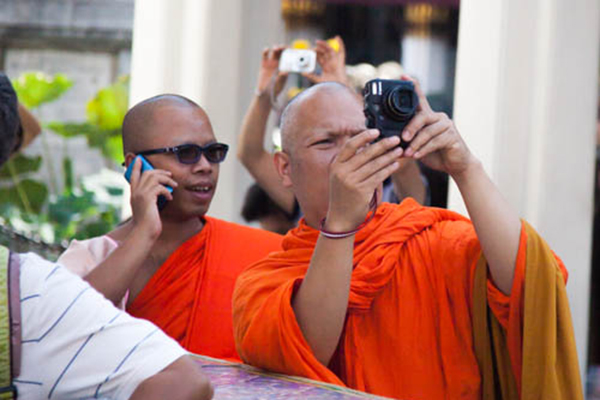
Perhaps the most visible signs of the increasingly uncomfortable relationship between Buddhism and consumer culture are Thailand’s monks, some of whom seem to be embracing modern-day accoutrements rather than a traditional aesthetic lifestyle.
Can you find enlightenment while surfing Facebook on your smartphone?
Our hunch is it might be distracting, but we’re hardly experts.
“Consumerism is now the Thai religion,” Phra Paisan Visalo, one of the country’s most revered monks said last year. “In the past, people went to temple on every holy day. Now, they go to shopping malls.”
Phra’s words seem especially relevant now when you consider the slew of scandals surrounding corrupt monks like Wirapol Sukphol.
While it shouldn’t have much impact on the debate, an American publication Quartz recently weighed in by arguing that, yes, consumerism in fact the new Thai religion and that maybe that was for the best.
The retail business of supplying products for monks is worth about 10 billion baht, or $320 million.
So while they may be holy, they’re also a market and a lucrative one at that.
In a sign that monk consumerism is growing, a mega-supply store on the outskirts of Bangkok, Hang Sangkapan, or “Monk Supply”, is hoping to franchise and find investors. Modeled after big-box retailers like Carrefour, the store offers a bevy of religious clothes, candles, Buddha statuettes and altar tables for Thailand’s robed men, Quartz reported.