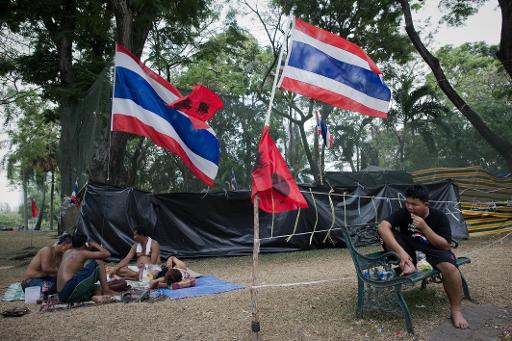

Thai anti-government protesters rest at Lumpini park in downtown in Bangkok today, March 21. Photo: Nicolas Asfouri / AFP
New elections are set for July 20 to try to end the deadly, six-month political crisis, even as legal challenges threaten to force Prime Minister Yingluck Shinawatra out of office.
The nation, riven by years of political unrest, has been without a properly functioning government since December, causing policy paralysis that has sapped the strength of its once-buoyant economy.
Yingluck is pinning her hopes on re-election to shore up her legitimacy following months of mass street protests seeking her resignation to make way for an unelected “neutral” prime minister to implement anti-corruption reforms.
A general election in February was voided after demonstrators disrupted voting, and the anti-government movement vowed Wednesday to oppose fresh election without reforms first.
“We will move forward with our reforms before an election. We will not talk!” firebrand protest leader Suthep Thaugsuban told supporters, vowing a “big mission to regain our sovereignty” starting on May 14.
The backdrop is an eight-year struggle between a royalist establishment – backed by parts of the judiciary and the military – and Yingluck’s billionaire family, which has traditionally enjoyed strong support in northern Thailand.
Twenty-five people have been killed and hundreds wounded, including many anti-government protesters, in grenade attacks and shootings in recent months.
Whether Yingluck’s name will be on the ballot paper on July 20 remains unclear. She faces two legal cases that could see her suspended from office and banned from politics within weeks.
The Election Commission, which agreed on the poll date in talks with Yingluck on Wednesday, has been accused by government supporters of siding with the opposition.
Observers also noted that the voting date left plenty of time for the legal proceedings to be wrapped up first.
“The intention of the [commission] is not aimed at having an election anyway,” said Puangthong Pawakapan, professor of political science at Bangkok’s Chulalongkorn University.
“I think something will happen that will force Yingluck to stop performing her duties” before the vote, she said.
The opposition Democrat Party, which boycotted the February poll, voiced dismay that the election date had been announced while its leader Abhisit Vejjajiva was seeking support for his own plan to end the deadlock.
“It’s very disappointing that all of a sudden Prime Minister Yingluck fixed the election day while earlier she agreed to meet with Abhisit to find a solution for our country,” said party spokesman Chavanond Intarakomalyasut.
Abhisit has not yet revealed his blueprint for ending the standoff but he has previously backed the protesters’ calls for vaguely defined reforms before elections.
Yingluck is accused of dereliction of duty linked to a loss-making rice subsidy scheme and of flouting the law through the improper transfer of a senior civil servant.
Her opponents say she has presided over rampant corruption and nepotism, and have accused the government of trying to influence the judicial process.
But her supporters see the legal moves as an attempted power grab.
While re-election would not give Yingluck legal immunity in the two cases, it might make opponents think twice about risking the anger of her supporters, who plan to stage a major rally next week to coincide with her appearance in court.
Thailand has been bitterly divided since a coup in 2006 ousted Yingluck’s brother Thaksin Shinawatra as prime minister.
Thaksin still wields huge influence from self-exile in Dubai, where he lives to avoid prison for a corruption conviction.
Mass protests in 2010 by the “Red Shirts” street movement, which is broadly supportive of Thaksin, triggered a military crackdown under Abhisit’s government that left dozens dead.
Election Commission secretary general Puchong Nutrawong said he was “confident that the election will be a success.”
But some independent observers expect protesters to try to thwart voting again.
“It is doubtful that elections can come off smoothly this time as there has been no change favouring the anti-government protest movement, and it is likely to obstruct elections again,” said Thailand-based author and scholar David Streckfuss.
Story: AFP
Related:
AFP: Democrat no-show hinders election talks
o new elections before July 20, commissioner says
Protest-plagued Thailand holds Senate elections
Elections 2.0 scheduled for April
Poll re-runs pass peacefully as Red Shirts gather
Turnout figures suggest about 1 million voted Sunday
Protesters disrupt voting in tense polls
Violence, protests blight advance voting for disputed Thai poll