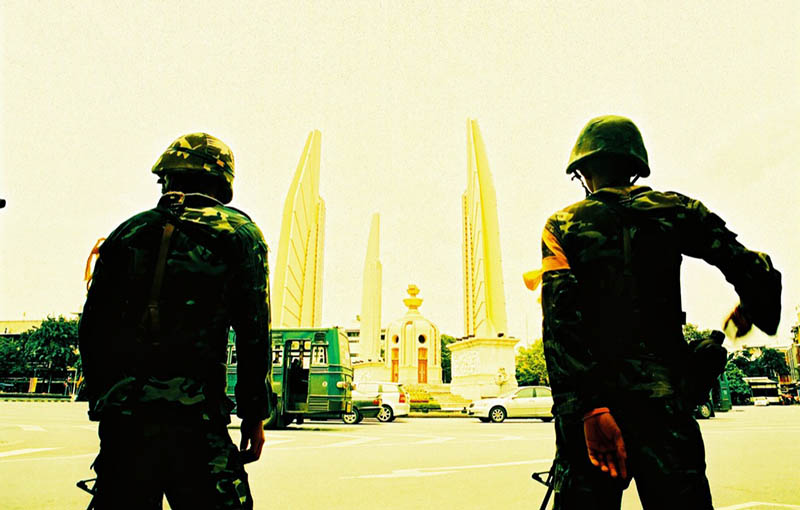

Five years after Gen. Prayuth Chan-o-cha declared he was assuming administrative authority to break political deadlock and end unrest, Thailand remains under de facto military rule that the recent election served to codify.
If history is a contest of competing narratives, those clashing perspectives were on display today with drastically conflicting evaluations of where Prayuth has taken the nation in the past five years.
To his deputy, whose power and clout have been essential to the stability of the ruling junta, they have been a time of selfless advancement of public well-being.
“We’ve done everything for our fellow Thai brothers and sisters,” said junta No. 2 Prawit Wongsuwan, who is also a deputy prime minister and defense minister. “Just look at how the government has done everything for the citizens to be able to live well. We faced a lot of problems, some which we found solutions to, some we have not yet, but nevertheless, the country has been peaceful and well-managed for the last five years thanks to the help of fellow citizens. As for the problems that we have not fixed yet, like low income, we will continue working.”
Thai Army chief stages military coup
To Sunai Phasuk of Human Rights Watch, the stability of the military government has been bought by draconian tactics and the silencing of opponents.
“Since Thailand’s military seized power on May 22, 2014, the country has faced unending repression of fundamental rights and freedoms,” he wrote. “The junta has routinely enforced censorship and blocked public discussion on the state of human rights and democracy in Thailand. Hundreds of activists and dissidents have been prosecuted on criminal charges such as sedition, computer-related crimes, and insulting the monarchy for peacefully expressing their views.”
The public is conflicted as well, if the results of March 24’s flawed election are anything to go by. While nearly two-thirds of voters backed pro-democracy parties, the party to place first in the vote count was created to perpetuate Prayuth’s time in power.
The online arena, where demographics skew younger, has moved toward a broadly anti-junta consensus five years after it showed wide support for the “Bangkok Shutdown” that ushered in 2014’s military takeover.
“We can conclude that in five years, the NCPO majorly screwed things up. We should be called a #DogShitCoup,” user Ritta41 tweeted today.
สรุปได้ยังว่า 5 ปี คสช.
เละเทะยิ่งกว่าเสียของ ต้องเรียกว่า #รัฐประหารเสียหมา
.— █ Ghost Writer █ (@RITT41) May 22, 2019
“The fact that the NCPO hasn’t respected the citizens’ voices once over the last five years is exactly why they are still around. The NCPO is the enemy of our democracy,” wrote user Pipob yesterday along with an attached photo of the 14 students that stood up against the junta 2015.
เพราะไม่เคยเคารพเสียงประชาชน 5 ปีแล้ว คสช.จึงยังไม่ไปไหน
คสช.คือ #ศัตรูของประชาธิปไตย https://t.co/M0ci3PZMZv
— Pipob (@pipob69) May 21, 2019
Other figures took the opportunity today to weigh in on what five years of illiberal rule has brought.
Piyabutr Saengkanokku, secretary-general of the staunchly anti-junta Future Forward Party, took to Twitter this morning to express his exasperation.
“When they took over, the NCPO (National Council for Peace and Order) said we just needed a little more time, but it’s been over five years, and Thailand still does not have a government chosen by the people from a fair election,” he wrote.
“รัฐประหาร” กับ “ปฏิวัติ” ต่างกันอย่างไร เหตุแห่ง “รัฐประหาร” ทุกครั้งในประเทศไทยใช้ข้ออ้างอะไร ทำไมครั้งล่าสุดโดย คสช. ที่บอกว่า “ขอเวลาอีกไม่นาน” จึงอยู่นานตราบจนวันนี้ 5 ปีผ่านไปประเทศไทยก็ยังไม่มีรัฐบาลที่มาจากการเลือกตั้งของประชาชน วันนี้ 1 ทุ่มตรง พบกันที่เพจพรรค #อนาคตใหม่ pic.twitter.com/TjG2omzPg5
— Piyabutr Saengkanokkul (@Piyabutr_FWP) May 22, 2019
The man who said five years ago that he was forced by circumstances to seize control, meanwhile, sees a legacy of good stewardship.
“The government has fixed a lot of problems over the last five years including peacekeeping, corruption, modernizing the law, informal debt and returning land deeds to citizens. We’ve all had to adjust to a lot of unforeseen challenges we’ve faced,” Gen. Prayuth told reporters yesterday, adding that he hopes the next government – which he’s likely to lead thanks to rules written under military supervision – will continue his junta’s good work.

Additional reporting Teirra Kamolvattanavith