
When the city life starts to wear you down, a trip out to the boonies like Ubon Ratchathani will help you appreciate all the best things about Thailand in ways that you’ve probably forgotten. From now until 5th August there’s an additional reason why you should make your way to this northern province of Thailand. We know it doesn’t sound like a “cool” event, but the annual Ubon Candle Festival is totally worth checking out.
‘Khao Phansa’ is coming! Wait…what is that?
The rainy season in Thailand is marked by “Phansa” which is the Buddhist Lent during which monks go into hibernation in their respective temples. Buddhist monks will stay within the temple grounds for a period of three months for study and meditation. Before electricity was invented, candles were the only source of light so people would gift candles to the monks for their “rain retreat”. Today that tradition has turned into a full-blown candle parade featuring larger than life candle wax carvings that depict some of the most famous Buddhist images such as the Sleeping Buddha, Ganesh, historic Thai warriors with their majestic horses, and other imagery from Thai folklore. This year AirAsia has flown in nine international artists who will also be contributing their candle wax carvings to the Ubon Candle Festival. These candle wax artworks by artists from Taiwan, Germany, Japan, Turkey, Argentina, and Romania to name a few, cover subjects that are more broad and deal with international issues rather than just Thai culture.
Who knew visiting temples could be so much fun?
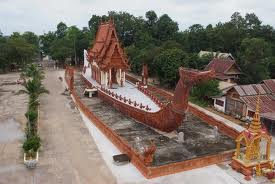
Our first stop in Ubon Ratchathani was the Wat Thung Si Mueang Temple, the proud winner of last year’s Udon Candle Festival. There are several techniques for candle wax carving and this temple uses the elaborate method of carving small ‘petals’ of wax that are stuck together to cover a large structure made of lighter material like styrofoam or hairy coconut husk. The working conditions are tough as the weather can be unforgivingly hot, which also makes the wax peel off and re-touching is needed before the big day of the parade which happens on August 3.
The monks at this temple do most of the work in making the elaborate candle wax floats, but volunteers are also welcomed to join in. After watching the monks roll out the petals on blocks of stone etched with the designs, I thought it would be easy enough to try without making a fool of myself. There was one bucket holding cubes of solid wax and another bowl filled with water and softened wax. When I reached into the bowl with the softened wax, I nearly jumped out of my shoes! Scalding water was used to soften the wax… why that simple logic didn’t click in my mind beforehand was beyond me. The trick is to get a pinch of the warm wax without lingering in the water too long – I learned the hard way. Then I placed the small ball of wax onto the stone mold and rolled the glass bottle against it just like I saw the monk do, but I failed – only half of the artwork made it onto my wax petal. Not to mention my contribution to their beautiful wax sculpture was almost twice as thick as it should’ve been. Luckily the wax can be melted again so nothing goes to waste. In fact, each year the wax from the floats are melted and saved for the following year.
At the second temple, Wat Burapha I’d gotten over the near water burn incident from earlier and worked up enough courage to carve some actual wax petals. My fear was that I would totally suck at it, but it was actually easier than I’d imagined. Still, I felt like each piece I made was different from the last one. I guess with a thousands stacked over each other and side by side no one’s going to really care about the precise lines, right? The whole process was almost therapeutic and I wanted to sit there carving forever but my hands got tired fast. The best part of the experience was being there with the locals, who were so inviting and kind. They kept saying how “suay” or beautiful my carvings were and I kept telling them how “sanook” or fun it was to do it.
All the amazing food you’ll get to eat there
We can probably all agree that first impressions of a place are really important, especially when it comes to food. Ubon Ratchathani has got you foodies covered, especially if you love trying new and interesting Laotian-influenced cuisine. For the first meal of the day, Sam Chai Coffee shop serves up an incredible breakfast that’s loved by both locals and international visitors. The food here is heavily influenced by nearby Laos. Our favorite dish was the Kai Grata or Pan Egg which consists of two sunny side up eggs topped with sweet sausage served in a small pan. You also get a roll of soft bread stuffed with thinly sliced sausage.
We had lunch at the Indochine Restaurant which was just divine. There’s definitely some magic going on in that kitchen because everything we ordered was amazing and totally affordable too. There was just one down side to the restaurant: the service. You know how it’s a huge turnoff when people know they’re attractive and they start acting like it? Well, Indochine is a restaurant that knows it’s goooooood and that we’ll be coming back for more regardless of how many times we have to flag down a waiter.
There are also a bunch of hole in the wall food spots that serve the common Thai meal of noodle soup. We found a random one that I can’t even name because everything was written in Thai. The place was packed with diners in the early evening so we knew it would be good as we took our seats. We each had a bowl of Vietnamese influenced noodles topped with an assortment of meat options of chicken feet, pig’s blood, chicken leg, and pork ribs. For those who have never tried chicken feet, you basically suck the meat off the sole of the feet. It’s one of those things that you either love or can’t even stand watching someone else eat
Cross the border and pay a visit to a whole other country: Laos!
The town of Pakse, which means “Mouth of the river Se” is a countryside place where you can expect to see ox grazing the grass fields. Other than the common stray dogs you’ll also find goats strolling about. We didn’t mind the random mosquito bites. It’s a small price to pay to be surrounded by nature’s beauty. Laos is another place where we had some amazing food. The Delta Coffee Shop seems like a fairly popular place with tourists since the menus were bilingual in Thai and English. Prices are very reasonable, a meal for five cost only THB1000. We had the usual fare of som tam, fried chicken, sticky rice, tom yum goong soup, omelette with pork, stir fried ground pork with herbs, and broccoli. Everything was tasty and we left with a couple bags of Delta coffee beans as souvenirs. Then we visited the Phasuam waterfall which was connected to the Katoo Ethnic Village by a shaky bamboo bridge. We saw different styles of traditional huts here with one called the Talieng house where a woman was making quilts. She used a manual “machine” that required her entire body including her feet to prop up the thread and sticks. It was so mesmerizing to watch these beautiful designs take shape with each push and pull.
We exited the village we saw our van pull up seemingly out of nowhere. This wasn’t where our driver, Nid had dropped us off, so we were surprised and pleased at the perfect timing. No need to walk over the scary bamboo bridge again. However the slight drizzle had turned the soil into mud which our shoes were covered with now. Nid had thought of everything! He gave me a piece of cardboard to wipe off the mud and inside the van he had lined the floor with cardboard so our soiled shoes would not dirty it. Hiring a driver with a minivan is probably the best way to travel to these foreign parts where taxis are not common. It’s about THB1800per day not including petrol (which is about THB800 a day depending on how far you travel). Nid can be reached at 089 6272175, but he speaks very little English.
—
Sometimes you gotta get out of the city. Weekender is Coconuts Bangkok’s travel feature series on destinations that can be enjoyed on a weekend trip from Bangkok.