
Phuket is an island that is as divisive as it is beautiful.
We have all been guilty of going on holiday somewhere new, spending a few days in one area, and coming to a damning assessment of the whole place without seeing what else it has to offer – tourists who come to Phuket are no different. People who only see Patong – Phuket’s most well-known tourist area, a little slice of Pattaya – will probably have memories of a trip wasted. But Phuket is an island the size of Singapore that is meant to be explored.
[[{“type”:”media”,”view_mode”:”media_original”,”fid”:”16767″,”attributes”:{“alt”:””,”class”:”media-image”,”height”:”452″,”typeof”:”foaf:Image”,”width”:”605″}}]]
Alas, most tourists do head straight to Patong, which has the worst beach on the island and is home to touts, jet-ski operators, millions of tuk-tuks, and generally the lowest denomination of holidaymaker. Many people claim to have “seen” Phuket by being whisked away from the airport in minivans and taxis to locales like this, never to be seen again until they return back at the airport to board a flight home with numerous stories and God knows what diseases. These tourists are happy with their break in the sun and feel they have experienced Phuket by spending it staring down the barrel of an empty bottle and finding “true love” down loud neon-lit sois every night.
Phuket Town on the island’s lesser-known east coast is happily lacking in these types of tourists and all the wretched things that come with them. It is a part of the island brimming with dilapidated mansions, lush hills and parks, and markets and restaurants patronized by locals. This is the center of Thai life on the island, and those who venture here will be rewarded.
[[{“type”:”media”,”view_mode”:”media_original”,”fid”:”16753″,”attributes”:{“alt”:””,”class”:”media-image”,”height”:”425″,”typeof”:”foaf:Image”,”width”:”605″}}]]
Sino-Portuguese Style
The old quarter of town around Yaowarat, Dibuk, and Thalang roads is filled with colorful old Sino-Portuguese shophouses with shutters on the windows and archways extending over the pavement. It’s the same type of architecture that is the legacy of Chinese migrants (called Peranakans) in Singapore, Malacca, and Penang. Chinese and Thais happily mingle with the Malays and Indians who run the Batik and cloth shops on Thalang Road. If you do lose your way wandering round, chances are you will stumble across some hidden gems like a color-coded back street brimming with art shops, bars and restaurants or a miniature Thai temple hidden away behind trees. One of the best examples of Sino-Portuguese architecture is the China Inn on Thalang Road, which has been lovingly restored and converted into an antique shop and cafe by a Phuket born-and-raised multi-generation Peranakan.
[[{“type”:”media”,”view_mode”:”media_original”,”fid”:”16755″,”attributes”:{“alt”:””,”class”:”media-image”,”height”:”454″,”typeof”:”foaf:Image”,”width”:”605″}}]]
Get High
Looming above the city is Rang Hill, the highest point in town. A drive up the windy leaf-strewn road takes you past joggers and cyclists struggling to make it to the peak. A number of shops and restaurants sit atop the hill, but the main reason people come is for the view over Phuket and out to Phang Nga Bay and the Andaman Sea. More and more tour groups are herding their clients up here for photo opportunities so be prepared to share the view with a number of others including groups of marauding monkeys.
[[{“type”:”media”,”view_mode”:”media_original”,”fid”:”16757″,”attributes”:{“alt”:””,”class”:”media-image”,”height”:”452″,”typeof”:”foaf:Image”,”width”:”605″}}]]
Mini-Chatuchak
Phuket Town is not short on shopping options either, from cheap and touristy stores to designer brands at Phuket’s own Central shopping mall. But if you want to shop like the locals, head to the weekend market off Chaofa West Road, opposite Naka temple. Open in the evening on Saturday and Sunday, expect a hot and crowded experience. The tarpaulin roof is not made for people over 5 foot 4 so prepare to walk around hunched over if you are average height. This is Phuket’s mini-Chatuchak and everything from animals to antiques can be found here, but it’s dominated by clothes and accessories. Being Thailand there is also an extensive food area with every dish you can imagine – many local to Phuket. Try the freshly deep fried tod mun pla fish cakes. Another insider’s tip: In the back of the market there are a couple of bars if the stress of shopping becomes too much.
[[{“type”:”media”,”view_mode”:”media_original”,”fid”:”16758″,”attributes”:{“alt”:””,”class”:”media-image”,”height”:”452″,”typeof”:”foaf:Image”,”width”:”605″}}]]
Rowdy Locals
Fancy a bit of football and local color? Then check out the Southern Sea Kirin, Phuket’s local club named after a mythical creature that appears with the arrival or passing of an illustrious ruler. FC Phuket fans at Surakul Stadium are forging a bit of a reputation for themselves and it is not all good. It is not unknown for fans to threaten referees, intimidate a manager to such a degree that he quits straight after a game, and hurl bottles and harsh words onto the pitch. The ground is split into two sets of home fans – The Hulks and Hardcore – the legacy of a dispute involving a bus trip to an away game. The Hardcore fans spend games sitting on the side of the ground with no roof drinking beer and smoking cigarettes, and have been known to insult the Hulks on the opposite side as much as the away fans. Beer is allowed into the ground and tickets cost around THB80, which is a bargain for an afternoon watching characters you don’t see anywhere else. Oh, and they do play a bit of football there.
[[{“type”:”media”,”view_mode”:”media_original”,”fid”:”16760″,”attributes”:{“alt”:””,”class”:”media-image”,”height”:”605″,”typeof”:”foaf:Image”,”width”:”605″}}]]
Most Importantly: Food
Phuket is majorly underrated in Thailand as a food destination. Long an international hub, Phuket’s local food is a mixture of southern Thai (fiery curries, bitter but tasty sataw beans, kanom jeen rice noodles) and Peranakan Chinese (dim sum, khao mun gai chicken rice, jok and khao tom rice porridge) with Indian and Malay influences. And there is no better concentration of deliciousness on the island than in Phuket Town.
The quintessential Phuketian morning meal is, perhaps surprisingly, dim sum. With its Chinese origins, Phuket Town plays host to a plethora of small eateries serving up the cuisine. One of the best is Phuket Pochana on Wirat Hongyok Road. An upstart to the dim sum scene that opened just a few years ago, the restaurant serves excellent classic dishes like chumai, ha kao,and salapao, as well as some well-executed Thai fusion variants. For your Isaan fix, try Sieng Can on Mae Luan Road, which serves a mean nam tok moo grilled pork salad and tom zaap spicy pork soup. One of the best latenight, booze-soaking meals is a bowl of incredible khao tom from Goh Ben, full of toothsome pork meatballs and nutty greens.
[[{“type”:”media”,”view_mode”:”media_original”,”fid”:”16762″,”attributes”:{“alt”:””,”class”:”media-image”,”height”:”452″,”typeof”:”foaf:Image”,”width”:”605″}}]]
But Phuket’s tremendous Thai seafood is probably where the island does get its culinary due, and is worth the trip alone. Raya restaurant – in another beautiful Sino-Portuguese shophouse on Dibuk Road – has the best damn gaeng boo yellow crab curry you may ever have, full of gigantic and succulent pieces of de-shelled crab meat, eaten with thin kanom jeen noodles with fried garlic sprinkle garnish. It can set you back as much as THB600 depending on crab prices but it’s worth it. Other Phuket specials served here include pad pak liang, a stir fried tasty green that’s unique to Southern Thailand served with either egg or big dried shrimps, and moo hong, Chinese-style pork belly braised in a sweet and fragrant spice sauce. Other legendary seafood spots in and around Phuket Town include Paknam, Ang, and Laem Hin restaurants. I’d tell you where they’re located, but then that would ruin half the fun of finding them right? Order pla nung manao – lime and chili whole steamed snapper or seabass fresh from the Andaman; lukchin pla – freshly made fish balls served with spicy green seafood dipping sauce; deep fried tamarind prawns; any type of oyster or clam; and more crab curry, a specialty of the island.
[[{“type”:”media”,”view_mode”:”media_original”,”fid”:”16764″,”attributes”:{“alt”:””,”class”:”media-image”,”height”:”452″,”typeof”:”foaf:Image”,”width”:”605″}}]]
Suay restaurant in Phuket Town may not serve the most authentic Thai fare (hence its popularity with expats) but it’s located in an attractive white house that is a good launching pad for a night out on the town. Most importantly it serves an extensive array of cocktails to wash down the food and get the blood flowing. A short stumble out of Suay will take you to a local yadong bar, which serves the Thai moonshinedisguised in Sangsom bottles and served in little tea cups. The crowd is an eclectic mix of local alcoholics, hopped-up farangs, and the occasional red-vested motosai driver taking a well earned break. The dilapidated wooden building filled with vintage trinkets only adds to the experience of drinking like a Phuket Town local. Another bar within stumbling distance (or crawling) distance is Sanaeha on Yaowarat Road. This bar located in yet another beautiful shophouse is probably the hippest watering hole in town and is popular with well-heeled Thais and expats in-the-know. The caipirinhas and mojitos are among the best cocktails in Phuket Town and will help you sway the night away. Saeneha closes at midnight though, but ask a few locals and you’ll quickly find that no-one is going home. Latenight clubs come and go in Phuket Town but hot right now is Sofa Boutique, which blasts dance-able techno and hip-hop to a mixed crowd until the late AM.
[[{“type”:”media”,”view_mode”:”media_original”,”fid”:”16766″,”attributes”:{“alt”:””,”class”:”media-image”,”height”:”452″,”typeof”:”foaf:Image”,”width”:”605″}}]]
Beach It Up
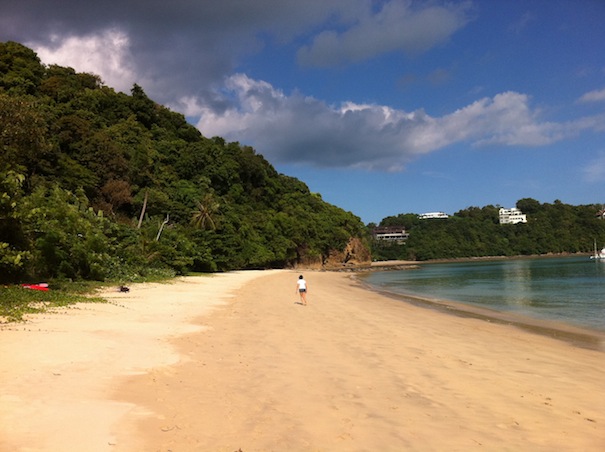
After a night of eating and drinking, a trip to the beach is the best way to recharge the batteries. A 15-minute drive out of Phuket Town into the jungles of Cape Panwa offers beautiful vistas and ultimately brings you to the beautiful bay of Ao Yon. The beach is hidden from the road and accessing it involves parking up and wandering down mini-sois to the beach. Ao Yon is rumored to be owned by a Muslim family who split different areas of the beach up among themselves. There are no hotels on the beachfront, which means a couple of nearby hotels struck a deal with a member of the family to bring tourists down to the beach and set up a sort of beach bar area. Thankfully, this is only a tiny area of the beach and is never busy.
Coconut palms line the back of the beach, the crystal white sand caresses your feet as you walk across it and the turquoise water glistens in the sun. If the sun becomes too much the tree line offers shelter. A tire swing hangs from an overhanging coconut tree for those who are young at heart. If you are lucky enough you may be the only person on the sand, laughing at those folks on the other side of the island fighting off touts and tuk-tuks.