
When I stepped inside Ben Viapiana’s denim workshop for the first time I was convinced he was running some sort of small sweatshop. One look at the antiquated sewing machines and scraps of denim everywhere had me wondering where he was hiding the Burmese child laborers.
I was completely off the mark. The second I started talking denim with Ben it all starting making sense and the collection of machines and tools slowly morphed from something reminiscent of Sinclair’s The Jungle into a modern-day Gipetto’s workshop.
“As of now I have fourteen usable machines and two really old ones that are just for show. There is no comparison between the new Chinese-made machines and hand crafted machines that were made in America or Germany ninety years ago,” said Ben.
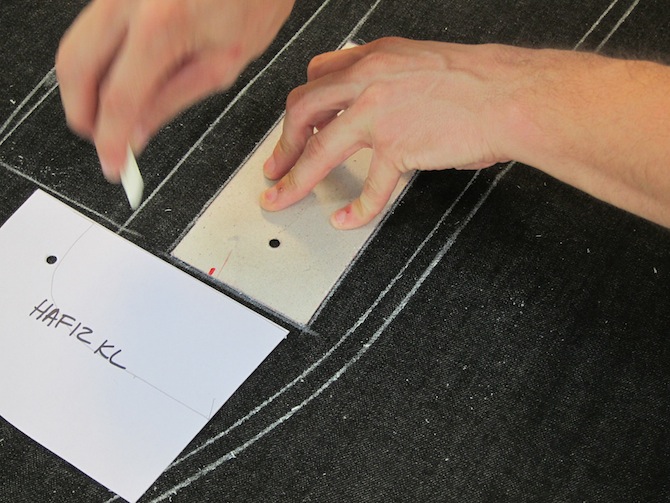
Anyone who thinks one pair of jeans is just as good as the next owes Ben a visit. To him and many other discerning denim-heads around the world crafting denim is quite simply an art. Ben spends hours making these garments by hand using century-old machines while most department store jeans are made on an assembly line by robots.
So what qualifies denim as art?
“Its all about the fade. Every fade is unique.” The fade he’s referring to is the pattern which forms in places that face the most wear and tear on a pair of jeans. Since every person’s body or stride is a bit different, the way the jeans fade over time varies between wearers. Nothing kills a beautiful fade quicker than washing jeans, so Ben refuses to put his jeans in the laundry. He swears that sticking the jeans in the freezer inside a Ziploc bag keeps them smelling fresh.
It’s not only the machines that are old-school—Ben’s business model doesn’t involve advertising or marketing aside from his web site, instead it relies mainly on word-of-mouth. Friends are his biggest customers.
“I think that a tailor of any sort should be back in an alley somewhere where it’s a little hard to find him but worth the search.” Ben’s small workshop takes up the ground floor of a house in a residential area near the Punnawathi BTS stop, far away from the throngs of Indian-owned tailors lining Sukhumvit.
Could a business model like this survive in Ben’s home country of Canada?
Most likely it would have to be a hobby, rather than a full time operation. Ben thinks Thailand is the ideal location for his label – operating costs and rent are extremely reasonable, it’s easy to source fabric, and there’s an unexplainable x-factor that makes doing business in Thailand easy. To illustrate this, he told us how he managed to use his denim expertise to make border crossings easier.
“I go to Cambodia quite often to look for vintage sewing machines or to check out factories, so I end up spending lots of time in line at the border. One day a wonderful Thai immigration officer asked me why I’m always crossing the border, so I offered him a pair of my custom jeans. To make a long story short, he opens up a new line just for me every time I go to the checkpoint. He fills out my paperwork and it makes the trip so much smoother. Needless to say he loves his new jeans.”
Border officials certainly aren’t his typical customers, however Ben’s products have been known to cross boundaries. Last year Ben attended a denim event in Kuala Lumpur, where he took numerous orders from Malaysian customers.
Ben is currently experimenting with other products made from denim and leather. He plans to make bags, belts and vests in the near future.
To get your own custom pair of jeans head over to www.viapiana.ca or stop in his Sukhumvit 101 denim workshop to learn about how Thai construction workers own some of the most beautifully faded jeans in Asia.