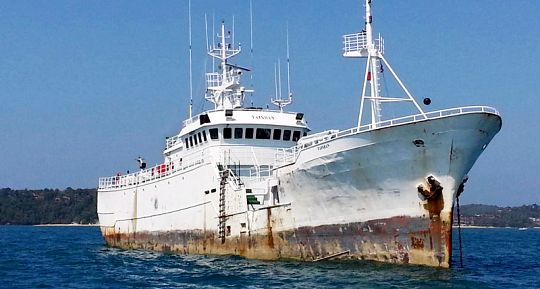

Having escaped Australasian navies, a renegade fishing vessel flying Indonesian flags under a false name will face catch-and-release by Thai authorities despite its role in the quiet conflict taking place over fishing rights. The Taishan was seized off the southern coast of Thailand earlier this month, as Tanyaluk Sakoot reports for The Phuket News:
PHUKET — An Indonesian-registered fishing ship, the Taishan, was seized at Phuket Deep Sea on March 6. Over the following days, a strange and complex tale has emerged.
The order for the ship’s arrest came after it emerged that the Taishan had until very recently been called the Kunlun, which was the subject of pursuits on the high seas by the navies of both Australia and New Zealand, which believe it was one of a fleet of six blacklisted ships fishing illegally in Antarctic waters.
The order for the seizure came after Thai Customs had received an Interpol Purple Notice, accusing the Kunlun/Taishan of illegally fishing for Patagonian toothfish inside an area regulated by the Convention for the Conservation of Antarctic Marine Living Resources.
The newly named Taishan, with 35 crew on board, was boarded by Thai officials when it came into Phuket Deep Sea Port and offloaded a cargo of eight refrigerated containers holding 182 tonnes of fish. The paperwork said that the fish was grouper.
Authorities found that the Peruvian captain of the ship (the rest of the crew were either Spanish or Indonesian) was licensed to command vessels up to 300 tons, whereas the Taishan is 625 tons, and the ship had an unlicensed radio.
By that time the containers had already been sent to Songkhla, where they were scheduled to be put on another ship and taken to Vietnam.
Thai officials in Songkhla examined the cargo and discovered, after a battery of tests, that it was not grouper but snowfish.
Thai Customs are currently deciding whether the cargo should be destroyed because of this “lie,” or whether it must legally be returned to Phuket and loaded back onto the Taishan.
Jaroen Chamnangang of Phuket Customs said that once the licensing problems have been resolved (possibly with a change of captain), the ship will be escorted out of Thai waters and told to never come back.
The Australian request for the arrest of the ship cannot be complied with, he added, because it has broken no Thai laws.
“Right now we have to wait for the conclusion [of the licensing and cargo matters]. Our fishery laws are not strong enough [to do more].
Authorities in Indonesia, where the ship is currently registered, have been alerted and requested to be more strict.
The eventual release of the Taishan – even though it will be barred from Thai waters – will be a disappointment in an ongoing low-key war between nations and an armada of poaching vessels.
Eco-warriors Sea Shepherd allege that the Taishan and five other ships belong to a syndicate based in Spain called Vidal Armadores SA, one of whose owners, Manuel Antonio Vidal Pego, was arrested in 2011 and sentenced to a year and eight months for trying to unload fish caught illegally.
Kate Wilson and Mar Cabra of the International Consortium of Investigative Journalist reported at the time, “Trafficking in fish is a thriving global black market. It fuels organised crime and the rapid disappearance of the oceans’ most valuable species.”
Vidal Armadores owns a variety of ships that are constantly changing names and shifting registration from one flag of convenience to another.
The toothfish, better known to chefs as Chilean Seabass, is highly sought-after.
Stocks in Australian waters are considered to be large enough to allow sustainable, regulated fishing But elsewhere the fish have almost been wiped out, resulting in a rise in the price they can fetch in markets worldwide – if they can be landed without encountering problems with the authorities.
If the containers are returned from Songkhla, it is not known where the Taishan will try to land its cargo next.