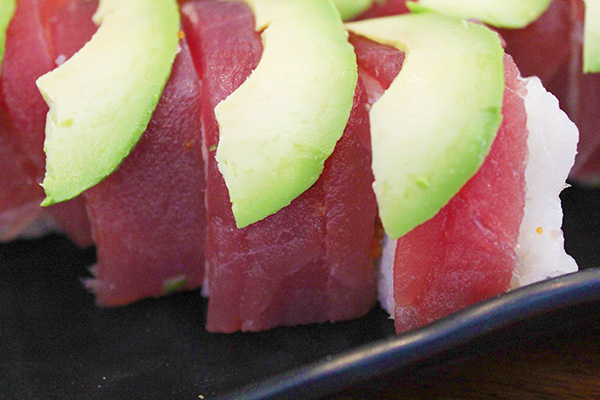

“We’ll have the Sushi Masa set, two pieces of toro, California rolls, and salmon sashimi.”
“Sorry, no salmon.”
Surely the best sushi place in Bangkok would have a healthy stock of the reddish-pink flesh on hand?
Thankfully my exchange with the waiter was a miscommunication. They did have salmon, just not what I’d hoped for.
Wild salmon eat crustaceans that contain a pigment called astaxanthin, and in turn the pigment dyes their flesh that beautiful deep pink. As soon as the first plate of sushi arrived at our countertop space I peered over at the chef and noticed he had procured a cut of saran-wrapped salmon from the display case. Tonight my filet was neon orange, meaning they were using a farm-raised variety of Salmon pumped full of growth hormones.
Not a good sign.
I came to Sushi Masa to see if what they say is true—that it serves the best sushi in town. Friends had talked about this place for over a year, I’d read about it and noticed it had amassed a whopping 17,000 likes on Facebook—unprecedented for a Bangkok dining establishment. Either this place had hired an excellent marketing firm, or it really built its reputation on stellar sushi and service.
I needed to know.
[[{“type”:”media”,”view_mode”:”media_original”,”fid”:”16727″,”attributes”:{“alt”:””,”class”:”media-image”,”height”:”400″,”style”:”display: block; margin-left: auto; margin-right: auto;”,”typeof”:”foaf:Image”,”width”:”600″}}]]
Sushi Masa is rumored to deliver loads of value, and a quick survey of the menu confirms that. A great idea for two people is the Masa Grand set, which rings in at a very reasonable THB1280 and includes two types of toro, scallop, tuna, squid, salmon (which we were forced to substitute) mackerel, eel, and some sort of unidentifiable brown paste atop a roll.
More on that later.
Since toro is the most prized slice of sashimi, we ordered up two additional cuts of the fatty goodness at THB480 a pop. The menu shows a pair of toro cuts for THB480, but be warned: you’ll only get one piece for that price. It’s a bit misleading.
The toro here is good, there’s no denying that—but since I came in to confirm whether it was the best or not I was slightly disappointed. Toro is the fatty underbelly of the Bluefin tuna. In much the same way humans can develop a “gut,” tuna can too. A tuna will develop a marbled, buttery, oily deposit of fat near the underside called otoro and then on the belly called chutoro. Fat mostly develops in the winter months when the fish needs to store energy to face cooler water temperatures.
[[{“type”:”media”,”view_mode”:”media_original”,”fid”:”16728″,”attributes”:{“alt”:””,”class”:”media-image”,”height”:”400″,”style”:”display: block; margin-left: auto; margin-right: auto;”,”typeof”:”foaf:Image”,”width”:”600″}}]]
But here’s the thing about sushi, and more importantly toro in Thailand – it depends when you eat it.
We visited in July, which is not the ideal time to an ideal fish.
The problem with that high fat content is that freezing destroys the flesh—so unless it’s being consumed within 24 hours of being caught, the toro must face a certain degree degradation in order to make it to its destination.
This is why all the really, really good stuff stays in Japan, where it fetches a small fortune.
Most of the toro we get here in BKK is second-grade chutoro, and that’s apparent at Sushi Masa. The melt-in-your-mouth feeling is there, but it’s clear that this isn’t anywhere near the best toro money can buy. To be fair, though, a piece of really top-notch otoro would fetch over THB1200, so at THB480 the toro here certainly delivers decent value.
It’s not worth getting hung up on the toro though, because the rest of the sushi here is done very well. The space is small, and the sushi kitchen is front and center. The sushi chefs put on a show by incorporating little tricks into their routines. While preparing our Masa platter, the chef tossed up the torch and watched it do a 360 turn before catching it and torching the assortment of mollusks.
It’s these fun gimmicky touches that bring this place down to a very approachable level. That’s the thing about sushi, it can be a bit intimidating if you haven’t memorized all the Japanese names for different cuts and fishes. Sushi Masa does a great job at creating a casual vibe where diners can be confident in exploring the menu and ordering whatever they want without worrying. The menu is a simple grid of pictures, so you know exactly what you’re getting.
Value is the strong suite of Sushi Masa, a set of six pieces of the popular akami, the rich red flesh a tuna yields, is a reasonable THB250 for six pieces. The ubiquitous California roll set, which also includes a healthy dose of tuna, is THB180. Prices on the a la carte menu are per piece, even though the pictures often depict one or more sashimi pieces or maki rolls, and most pieces ring in between 30-70THB.
So is ushi Masa the best sushi place in the entire city? Most likely not, we’ve had better—but with an easily approachable menu, a fun and entertaining team of sushi chefs, and prices that are just as digestible as a nice piece of Toro, it might be the best place to take a date or casually go sake bombing.
Sushi Masa, Siam Sawana Hotel, 359/1
BTS Ratchathewi