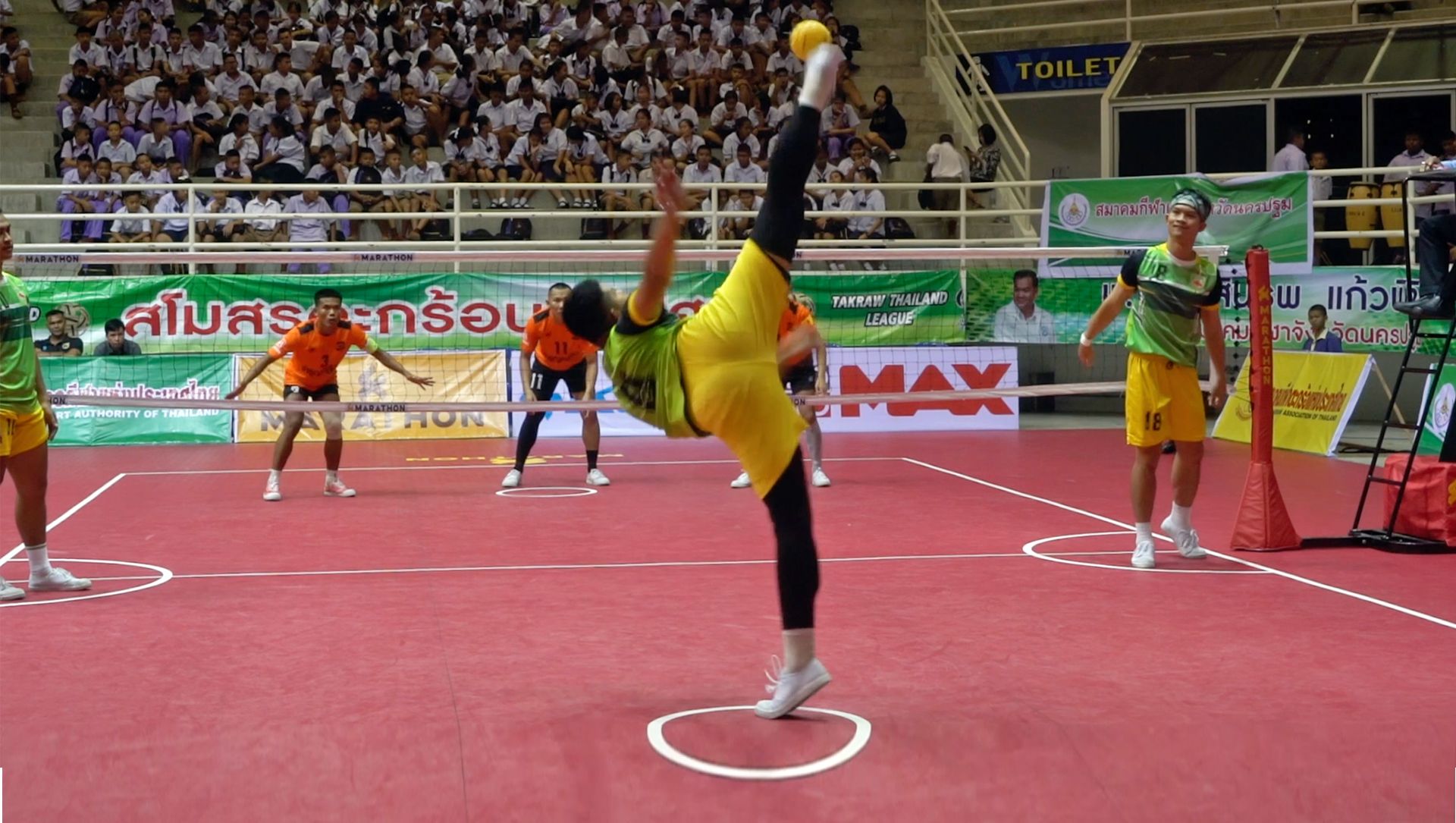

The crowd watches in anticipation as the 21-year-old player vaults his foot over his head in a standing split to send a woven plastic ball zooming over the net. His opponents pass the ball several times with their feet before one of them jump-kicks it back over.
At a glance, Sepak takraw shares some of the elements of volleyball, with a ball served, set and spiked across a net. But there’s one major caveat: Players are not allowed to use their hands.
What may strike the unfamiliar as an odd sport is in fact a storied regional tradition that’s helping send young sportsmen, such as these playing recently at a west metro Bangkok stadium, to a better future.
“There are big problems with drug abuse in my hometown, but I have never gotten involved with any of that. All I do is play sports, I don’t have time to mess with drugs,” Anan Chaichana, 21 of Khon Kaen, told Coconuts Bangkok with a small chuckle.
He’s a member of the Kalasin Takraw team which had traveled to the Nakhon Pathom Gymnasium Stadium to compete in the Takraw Thailand League.
Anan said he is most thankful for the free undergraduate education his years of takraw training are repaying him with. Years spent training often twice daily.
“I got a full ride to study management at the College of Asian Scholars in Khon Kaen” he said.
A number of players interviewed agreed that, for them, takraw was not only an exercise and artform unique to the region, but also a means for rural youth from troubled neighborhoods to find opportunities to earn incomes and a free education.
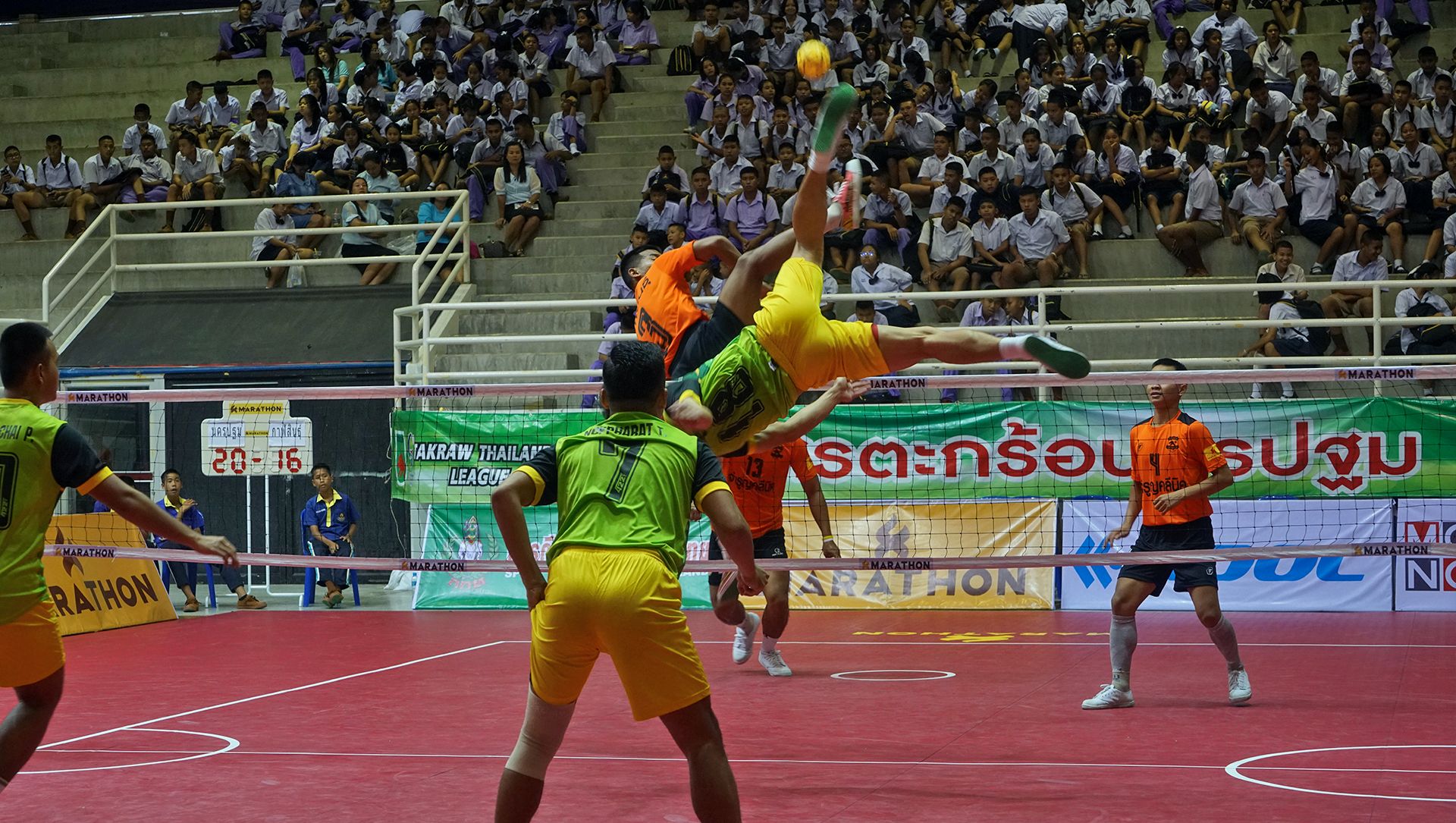
Today, the six-century old sport or some variant is also played in Indonesia, Malaysia, Singapore, Myanmar, Laos and the Philippines. It is also popularly played in Thai schools PE classes and remains a popular pastime for people of all ages. It can be seen played in school yards, parks and basically anywhere with open space.
Since 1999, successive Thai governments have declared substance abuse a national priority, though drug consumption, seizures and prosecutions continue to increase.
“The problem with drug abuse has seeped into every nook and cranny in much of rural Thailand, especially now that the economy is bad and people don’t have jobs. So a lot of them turn to drugs,” Kalasin team director Tanapol Tungkeeratichai said.
It’s a problem he says he sees with his own eyes. Tanapol runs an academy in the northeastern province that trains under-privileged children as young as 6, as he believes takraw can steer them onto the right track.
Tanapol says he’s played the sport ever since he can remember and loves it so much he named his firstborn “Takraw.”
Yeah, needless to say, Takraw is his whole life.

Take a peek into the world of Takraw and learn why Anan and other young players decided to play professionally.
‘Shaolin Soccer’
Sepak takraw – sometimes described by foreigners as “Shaolin Soccer” – can look bizarre to the uninitiated. Gameplay consists of three players on each side competing to score points across a net.
While players are not allowed to touch the ball with their hands, they can use just about everything else: feet, legs, heads, knees and chests. Many have described it as something of a cross between football and volleyball and played with a ball made of woven synthetic fibres.
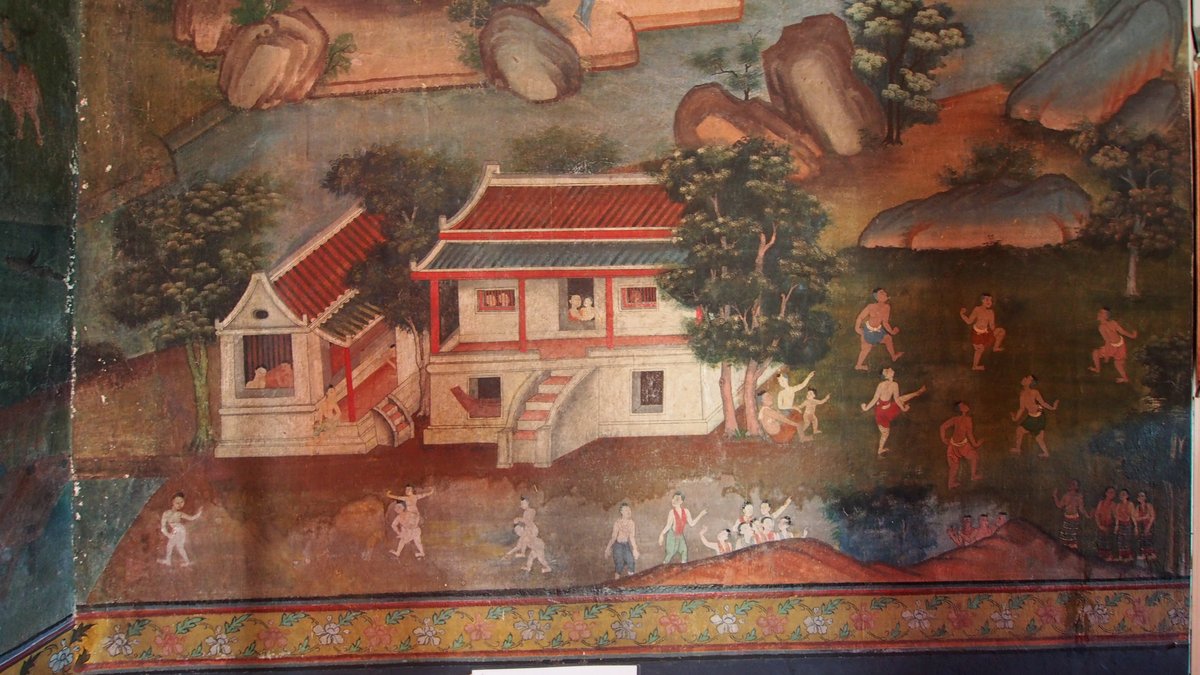
Thais are thought to have been playing takraw since around the 16th century Ayutthaya-era. The modern form began taking shape sometime in the 1700s. According to Takraw: A Traditional Southeast Asian Sport by author Shawn Kelley, the Siam Sports Association drafted the first official rules for Takraw competitions in 1929, and in 1990, it became a sport in the Asian Games – with Thailand dominating since with the most gold medals.
Mural at Wat Samuha Pradittharam in Saraburi showing people playing Takraw in the early Rattanakosin period. Photo: Voice TV
Sport of the Future?
Over the years, takraw’s popularity has grown worldwide. There are now 31 nations in the International Sepaktakraw Federation – the sport’s governing body established in 1988 – competing against one another.
The goal of the federation, as well as those in takraw that Coconuts Bangkok spoke to, is to get the game into the Summer Olympics. In order to fulfill the International Olympic Committee requirements, the sport must be popularly played in at least 75 nations to qualify.
Tanapol is hopeful that will happen. His counterpart for the Nakhon Pathom team is not as optimistic.
“I think Takraw is still a long way from the Olympics because it’s too regional. In order for it to be included, people need to play it much more in other regions,” Supato Banya said.
Underground Takraw
Played to just 13 points (as opposed to the standard 15), games are faster in underground Takraw and all the players are real amateurs — no pros present here. Matches can be played for high stakes prize money for as much as THB21k (US$2,988) or a more casual THB4,500 (US$148). Frankly speaking, most players are in it for the money, says organizer “Foo Original,” a pioneer of underground Takraw in Thailand.
Amateurs or not, underground Takraw is a thrill to watch — you just got to appreciate the level of acrobatics involved as the underground players fly through the air and serve the ball some swift roundhouse kicks

Related:
Thai badminton star cleared of doping as tests linked to meat
With swords and stunts, Thai youth embrace ancient martial art