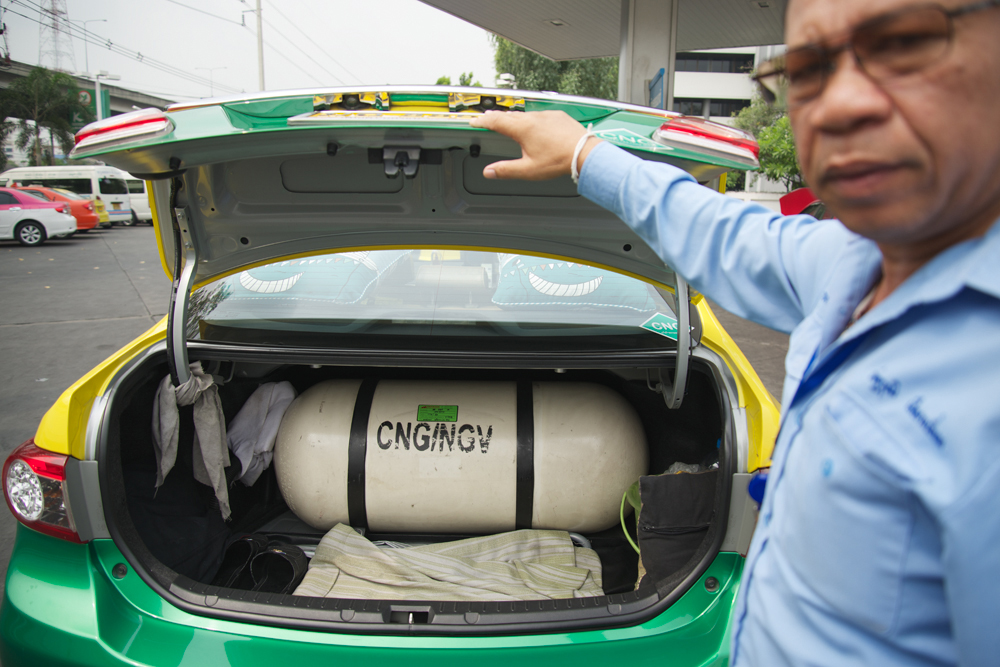

In Bangkok, you know there’s a problem when they start closing the malls.
This past weekend, shopping centers throughout the city shuttered their doors early, as they will continue to do until April 12, their intention being to save electricity.
Not only Bangkok’s favorite retail locations, but also its primary industrial plants will be curtailing their hours during the coming week. Toyota has agreed to scale back production at several of its plants, an austerity effort in which over 100 factories throughout Thailand have joined.
The government has called on Thailand’s citizens to conserve energy as well. With temperatures reaching to the searing level of 40-degrees Celsius, officials are worried that Bangkokians will take to using their air conditioners simultaneously, overtaxing the electrical grid and causing widespread blackouts.
The Petroleum Authority of Thailand (PTT), the Kingdom’s state-owned energy conglomerate, undertook the most richly ironic of these conservationist gestures.
On Monday April 8, PTT announced that some 600 of its natural gas filling stations would be shutting off their lights to save electricity, while another 700 stations would close early.
In this manner PTT wound up playing an essential role in both ends of an electricity crisis that blatantly illustrates Thailand’s relationship with, and ultimate reliance on, its western neighbor.
—
All the aforementioned countermeasures – from the reduced retail hours to the unlit filling stations – owe to one root cause: repairs being undertaken to the Yadana natural gas field in the Andaman Sea, west of Thailand.
Yadana, though far from the minds of many Bangkokians, has served as an essential factor in the city’s rapid expansion during the past two decades, and a crucial, complicated linkage between Thailand and its oft-troubled neighbor – Burma.
It’s difficult to overstate Yadana’s (and, in turn, Burma’s) importance to Thailand’s energy mix. Staggering statistics abound.
Last year, Anon Sirisaengtaksin, president and CEO of PTT Exploration and Production, PTT’s resource extraction arm, estimated that in the coming years, as much as 25% of Thailand’s natural gas would originate from Yadana.
Thailand has been responsible for nearly a quarter of the foreign direct-investment (FDI) that has entered Burma since 1989, and a remarkable amount of the foreign currency that has kept the Burmese junta in house and home throughout that period has come as a result of Thailand’s natural gas purchases.
Since natural gas first started flowing from the Yadana and Yetagun fields in the late 1990s, an overwhelming majority of that gas (as much as 80%) has sluiced directly down the Yadana pipeline, making a B-line for Thailand.
For Burma’s export mix, the value of natural gas can scarcely be overestimated. Last year, fossil fuels accounted for 46% of the country’s total exports, a percentage far greater than that enjoyed by any other product or commodity. An overwhelming majority of those fossil fuel exports wound up in Thailand, where they were used to fuel Bangkok’s cars, maintain its industrial plants and keep its air conditioners perpetually humming.
In 2012, Thailand purchased 40.3% of Burma’s total exports. Information released by Standard Chartered Bank describing the composition of those exports reveals that 93% came in the form of natural gas. The remaining 7%? – “Other.”
Thailand has paid dearly for these essential resources. A report from the Asian Development Bank (ADB) shows that between 2006 and 2010 alone, Thailand imported USD13.6 billion worth of Burmese goods, 91.3% of which were fuels.
During the past 20 years, border disputes between Burma and Thailand have occasionally put the two countries at odds, but at no point has this acrimony reached such a pitch as to stopper the Yadana pipeline.
Such is the energy relationship between Thailand and Burma that neither side can really afford to cease the flow of natural gas. Thailand needs the electricity; Burma needs the money.
As this week’s repairs amply demonstrate, the relationship between the two countries has grown into a state of heightened codependence.
—
Talk of exploiting Burma’s natural gas resources first began in the late 1980s. Two conditions existed that wound up creating the Yadana project: First, Thailand needed energy. A growing industrial sector and continued urbanization drove Thailand’s energy appetite, much as they do today.
Second was Burma’s relative seclusion. Having by that point achieved the status of international pariah, the Burmese junta desperately needed foreign capital in order to continue its reign. Rumor speculated that the regime’s foreign currency reserves had dipped lower than USD100 million.
The regime had received promising reports regarding natural gas resources located in shallow waters just off its shore, but lacked both the technology to exploit them and the means to ship them to market once retrieved. Already the subject of heated international acrimony, the military government had slim pickings when it came to foreign investors. France’s Total was willing to come to the table, but the deal wouldn’t work unless it had a market for the gas.
It found that market in Thailand.
PTT became a partner in the Yadana natural gas field, along with Total, Unocal (which was later acquired by Chevron) and the Myanmar Oil and Gas Enterprise (MOGE). This consortium launched the Yadana project in 1992.
Human rights groups have widely criticized the companies involved with the Yadana project both for the revenue the project has provided to the Burmese junta and the widely documented human rights abuses associated with the construction of the Yadana pipeline.
In addition to the use of forced labor, reports of mass relocations, extrajudicial killings and torture have trailed the pipeline’s construction.
Earth Rights International, a human rights organization that has closely tracked the Yadana project’s development, described the project’s use of forced labor as “systematic” and “commonplace.”
Human rights abuses notwithstanding, natural gas began to flow through the Yadana pipeline in 1998, providing an essential source electricity to Thailand and a steady flow of income for the Burmese junta.
None of the oil companies involved in the Yadana field have revealed how much money the Burmese regime has reaped from the project. Based on information gathered from documents released in lawsuits against the pipeline operators, Earth Rights International estimates that the Burmese regime profited in the neighborhood of USD4.6 billion from the Yadana project between 1998 and 2009.
—
Thailand’s present reliance on Burmese natural gas could not ask for a more apt demonstration than this month’s pipeline repairs.
With as much as a quarter of Thailand’s natural gas resources suddenly removed, the country has been forced to adopt drastic measures and dip into reserves in order to keep the lights on and the air conditioners running.
At this point, it appears as if these stopgap measures have circumvented an all-out crisis. On April 9, Energy Minister Pongsak Raktapongpaisarn announced that the days of highest energy demand had passed, and that the government’s countermeasures, which included the purchase of electricity from neighboring countries, had proven sufficient to meet Bangkok’s demands.
The fortuitous arrival of Songkran helped matters as well. During this weekend’s holiday, many Thais will be out of their houses and the country’s demand for energy will drop.
Yet, even with significant changes on the horizon for Burma’s natural gas infrastructure, it looks like Thailand’s commitment to its neighboring country is likely to remain intact.
As of last year, Thailand’s annual appetite for electricity stood at 169.4 billion kilowatt hours. Seventy-percent of that energy came from natural gas.
PTTEP has estimated that Burma possesses more than 25 years worth of natural gas reserves. Even though Thailand produces much of its natural gas domestically (one-third, according to Chevron’s estimation) and has other import partners, Burma is a trading partner it can ill afford to lose.
This month, Burma will auction 20 more offshore blocks for natural gas and oil exploration. With international sanctions against the country having loosened in recent years, several multinational players are expected to bid on access to these rich, fossil fuel reserves. This time around, Burma itself is likely to demand a portion of the pie. The country receives negligible portions of the Yadana and Yetagun bonanzas, a consequence of contracts entered into by a junta more interested in foreign currency than domestic development.
Even though China has recently launched projects aimed at exploiting Burma’s natural gas resources, Thailand, with its increasingly hearty appetite for electricity, is likely to serve as the primary destination for most of Burma’s natural gas.
As Burma continues its rocky transition towards democracy, a large part of the funds for that project will come directly from Thailand; and, as Thailand continues its bid to become ASEAN’s commercial center, it will have to keep looking westward for electricity with which to power its ambitions.
This week, these two powers have displayed just how precarious a deal keeping the lights on can be.
—
Photo: Kajonsak Intarapong