

The brainchild of Nicolas Vivin, a French expatriate, and his Australian-Thai wife, Samantha Proyrungtong, the brand VIVIN originally started off as a range of whole duck foie gras terrine and grew to include dried duck magret and caviar.
Now the brand has introduced a new line of goat cheeses that sold out completely at the temporary booth the brand have set up at the entrance of Emporium Gourmet Market.
The goat cheese is now available for purchase in a permanent corner at Central Chidlom Food Hall where free tasting will be available until September.
When speaking of his new line of goat cheeses, Vivin mentioned that he now takes regular trips to Chiang Mai to check up on his goats and the production facility there.
The new goat cheeses are handmade in the Northern province and the goats whose milk the cheese is sourced from are raised there by local French producers.
The new range of cheeses, which seem likely to conquer the Bangkok market, come in six different varieties: a 4-week aged ‘Colliné,’ a ‘Ricotta’-style, two semi-fresh varieties called ‘Bûchette’ and ‘Petit Blanc,’ and seasoned options ‘Fresh Black Pepper’ and ‘Fresh Garlic and Chive.’
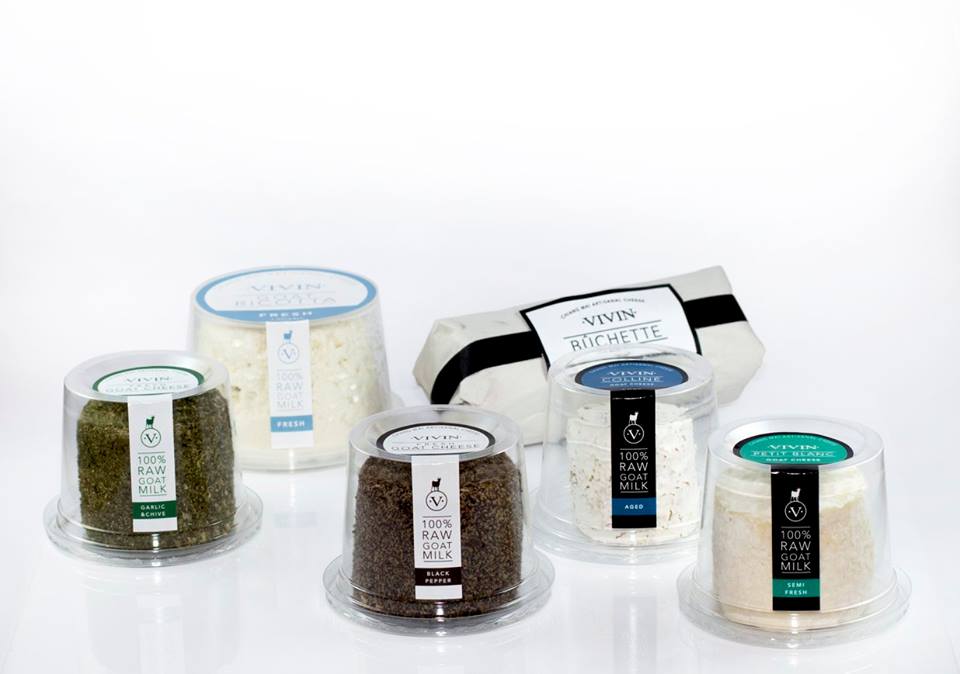
VIVIN’s new line of goat cheese
Now that VIVIN has found it’s footing in the fine-food scene, the couple happily recounted the humble beginnings that Vivin characterized as, “a combination of coincidence and serendipity.”
Influenced by small-town France
Hailing from Roanne, a small town in France best-known as the home of Michelin three-star restaurant La Maison Troisgros, Vivin seemed destined to work in the food industry.
While the town may have had some impact on him, his main influence was his family, who were food connoisseurs.
Vivin, in his thick accent, spoke fondly of his love of local French cuisines that are best enjoyed at family gatherings, where he and his cousins, aunts and uncles would feast on traditionally-made food. Vivin mentioned that his favourite dish as a child was the French delicacy lamb brain, a dish not commonly found here in Bangkok and not likely to be introduced as the next VIVIN product.
It was during these family gatherings that Vivin found inspiration in his biggest food influences, his grandmother and mother.
His grandmother, whose cooking veered towards the traditional, instilled in Vivin the knowledge of, and familiarity with, dishes that were basic to French home cooking, such as rich sauces and the aforementioned lamb brain.
His mother’s cooking, on the other hand, tended to have Asian influences. “She used lots of exotic spices, such as ginger and lemongrass mixed with ingredients normally used in French cooking,” said Vivin when speaking of her signature dishes.
Vivin’s formal training lies in the hospitality and service industry, which might explain his passion for dining etiquette.
Getting excited when he spoke about etiquette around the table, Vivin offered an anecdote about tea-drinking and why it is tradition for the proper tea-drinker to extend their pinky finger when holding a cup.
“In the past, food was consumed by hand and people would grow their pinky nail long to scoop up spices to garnish their food. Hence, it had to be kept clean.”
Bangkok Farmer’s Market
Before the formal launch of their brand, the husband and wife were a fixture at the Bangkok Farmer’s Market, selling their small-batch, homemade foie gras.
Those early experiences were thanks to Samantha who, despite not having a product to sell, was offered one of the first spots at the newly-opened farmer’s market two and a half years ago.
As the couple debated on what they could sell, Vivin realized how much he “missed his foie gras” and the idea for VIVIN was born.
The couple started experimenting in their kitchen, trying to come up with a great recipe and hit upon their signature ‘Natural’ flavored foie gras and the ‘Chalong Bay’ flavor, fortified by the small-batch, artisanal Thai liquor.
“There were many trial and errors before we perfected them,” said Samantha.
Describing the two flavors, Vivin said the ‘Natural’ flavor was whole duck foie gras with no additional flavoring. “It’s duck liver in its finest form. As for the ‘Chalong Bay’, it’s whole duck foie gras infused with sugarcane-fermented rum we sourced from Phuket.”
During their first times selling at the market, their products were an instant success and quickly sold out. “We were pretty taken aback that foie gras could be so successful, especially in Thailand,” Samantha recounted.
This solidified the couple’s decision to make VIVIN their priority as they plunged headfirst into the high-end food business.
Asked about the sense of community at the market, Vivin and Samantha spoke of the great relationships they made with the other vendors. “It’s where I met Joe Sloane, Michael Conkey, Pomezia, Maison Jean Philippe, and many more,” said Vivin of the other expat, artisanal food producers.
Today, Vivin’s company has gained recognition among expats as well as locals, who make up 60 percent of their customers. But it hasn’t been an easy road.
Early into their time at the farmer’s market, the couple ran into difficulties with production and packaging but, with those bumps behind them, they no longer make the foie gras themselves and have two employees who do so.
There was a resounding, “No,” from the couple when they were asked if they miss the days when they were elbow-deep in foie gras in their kitchen, trying to crank it out for the farmer’s market.
Vivin now spends his time tinkering with new recipes while Samantha handles marketing.
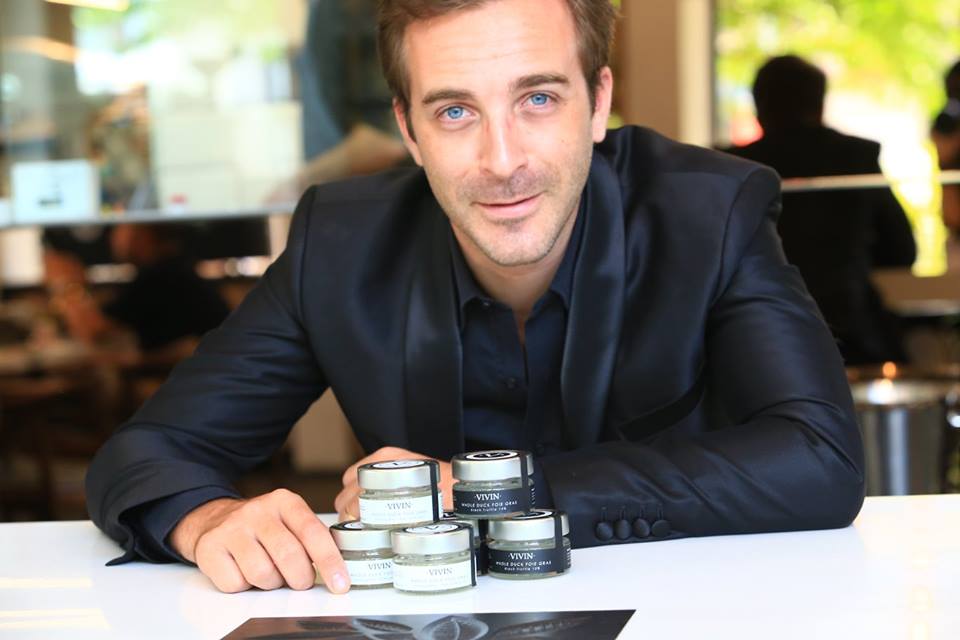
Nicolas Vivin with his line of whole duck foie gras terrine
Getting to the liver
Vivin explained the differences between the different kinds of foie gras. In order to call a foie gras a whole duck version, you must use only one or two livers per batch.
“Any more than that and it becomes just foie gras.” For that, it’s usually 98 percent liver from many different ducks. Bloc de foie gras is minced liver mixed together to create a smooth, homogeneous texture. Pate and mousse often only have 50 to 70 percent liver in them.
Whole duck foie gras ensures that the original texture of the duck remains. “When you taste it, you will get chunks of the liver,” explained Vivin of the kind of foie gras he creates.
Vivin also addressed the issues that commonly plague those involved in the foie gras business. Talking about how the ducks are traditionally force-fed, Vivin said the suppliers for VIVIN try to do it “the proper, traditional way” when asked about the ethical treatment of the ducks used in his foie gras production.
Delving into the production aspect of his products, Vivin said that he tries to work with small artisans as much as he can in order to better control the production process.
His dried duck magret, which is dried duck breast cured and seasoned with salt, is locally farmed in Thailand while the sea-salt that the duck is cured with is harvested in Phetchaburi. Citing the caviar pollution in Thailand, Nicolas noted that VIVIN’s caviar has to be sourced from Italy.
Thailand’s Food Scene
“We are entrepreneurs on a realistic budget” said Samantha with a laugh when asked to name their favorite restaurants.
Some of the couple’s favorite dining places are Nobu, Bann Ice, Saigon Recipe, Indigo, Kinjo Okinawa, and Supanniga Eating Room.
Asked what he thinks of the food scene in Bangkok, Vivin bluntly mentioned his dislike of people who enter a restaurant or cake shop just take photos of their order. “I think this is ridiculous. When you go to a restaurant, you go to appreciate the food, not take pictures. The food will just get cold.”
The couple agrees that most people here tend to care more about how food looks than how it tastes.
When asked if he eats junk food, Vivin said, “ I’ll have Daniel Thaiger, though that is good food. And Smith’s salt & vinegar chips,” he said of the chips the couple choose when having an occasional binge.