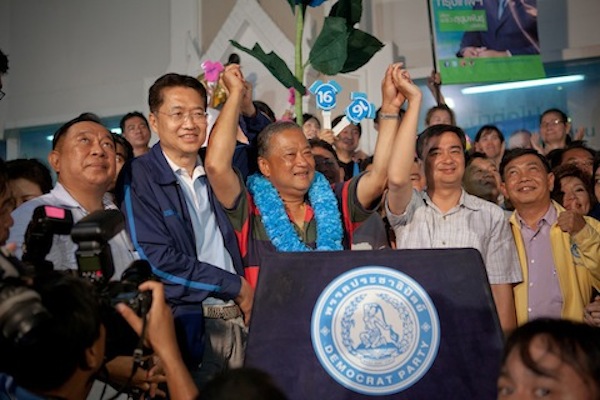

When all was said and done, Bangkok voters ultimately felt more comfortable sticking with the status quo.
Despite months of consistently weak survey data, and a media narrative painting his opponent, Pheu Thai nominee Pol-Gen. Pongsapat Pongcharoen, as decisively pulling ahead, incumbent Governor Sukhumbhand Paribatra defied expectations and secured a second term for himself at the head of the Bangkok Metropolitan Administration (BMA).
Both the rival Pheu Thai and Democrat parties devoted considerable time and resources toward securing victory in a poll viewed as having significant implications for both parties at the national level. Amidst record turnout, Mr. Sukhumbhand came away with over 1,250,000 votes to a tally of about 1,075,000 for Mr. Pongsapat. The win gives the Democrats a fourth consecutive term in which to head up the BMA.
So with Mr. Sukhumbhand’s political future secure for another four years, what significance does yesterday’s poll result herald for politics in Bangkok and throughout the Kingdom?
For Governor Sukhumbhand:
First and foremost, he gets to keep his job. Less than two weeks ago, when the campaign appeared to be largely dead-in-the-water, the incumbent openly contemplated life after elected office. As the official numbers started coming in, it quickly became apparent Mr. Sukhumbhand wouldn’t need to bother contemplating retirement any time soon.
Given the low expectations heading into election day, he will undoubtedly be buoyed by this surprising and decisive victory at the ballot box. Both the Democrats and Pheu Thai adopted a conciliatory attitude toward one another on Sunday evening, pledging to work together in a “seamless” manner for the benefit of the citizenry. Whether or not the Pheu Thai led national government can put aside their differences with the Democrat-run BMA remains an open question. The Bangkok administrative budget remains miniscule and Mr. Sukhumbhand will have to play nice with his political rivals to secure much needed funding and support from the central government.
For the Democrats:
The campaign result will be a shot in the arm for a party that has largely struggled in opposition since it turned in a disappointing result in the 2011 national election. In the past several weeks some ominous questions were arising as to whether or not the Democrats could remain a viable competitor to the Pheu Thai party machine. Retaining control of Bangkok, the traditional power base of the Democrat Party, will, at least temporarily, alleviate concerns among the party faithful.
Aside from the Mr. Sukhumbhand himself, no one is feeling more relieved at the moment than former PM and current Democrat Party leader Abhisit Vejjajiva. He played a visibly proactive role in helping with the re-election campaign and there was rampant speculation in the media that had the race gone south for the Dems it would have likely cost the former PM his job. While the path back to governing nationally remains long, at least the Democrats have walked themselves back from the abyss and Mr. Abhisit has bought himself a bit more room to breath.
For Pheu Thai and Pol-Gen. Pongsapat:
On the one hand, they came up short and their supporters are justifiably discouraged, particularly in light of some highly misleading poll numbers. On the other hand, there are some promising takeaways from the campaign. Mr. Pongsapat garnered over one million votes, an exponential increase in support for a pro-Thaksin party when compared against prior gubernatorial polls. The Pheu Thai man’s telegenic appearance and charismatic personality make it likely that he will maintain an important role in Pheu Thai politics for the foreseeable future.
While the result marks a setback for PM Yingluck Shinawatra and her brother Thaksin, it is important to put everything into perspective. The government’s public approval rating remains high and they consistently outperform the Democrats in national head-to-head polling. The economy turned in robust growth of 6.4% in 2012, including an eye-popping 18.9% rate in the final quarter. Economists are quick to acknowledge that the 2012 numbers may be a bit distorted due to inevitable bounce-back from extremely weak growth numbers in 2011 due to widespread flooding up and down the country.
Nonetheless, Pheu Thai economic policies have been well received by large segments of the Thai population. They retain a formidable party operation and continue to draw vast levels of public support in the more rural northern and northeastern parts of the Kingdom. Barring a severe economic downturn or political upheaval, Pheu Thai is likely to remain the dominant party in national politics for the time being.
For the city of Bangkok:
The status quo reigns!
It appears as though voters were not as easily seduced by the bold promises coming out of the Pheu Thai campaign as initially thought. A cornerstone of Mr. Pongsapat’s appeal was the premise that his administration would have been able to work more closely with the national government in making tangible progress on numerous large-scale infrastructure projects including proposed BTS extensions and the development of a regional light-rail line. With Pongsapat going down in defeat, his Pheu Thai allies in the central government will be less likely to allocate necessary resources to a Sukhumbhand-run BMA.
Most of the immediate analysis suggests Bangkokians were hesitant to reward control of both city and national government to a Thaksin affiliated party. In the final weeks of the campaign the Democrats stoked fears over a potential pro-Thaksin political monopoly to scare off voters from backing Mr. Pongsapat. In retrospect it seems that strategy worked out quite well, causing many undecided or independent-leaning voters to eventually break for the Democrats at the ballot box.
Lingering concern and hostility over the incidents of 2010, when Red Shirt protesters brought the city of Bangkok to a near standstill and burned down the Central World shopping mall, may have also been a significant factor in Sunday’s outcome.
The key dynamic going forward is the relationship between the Democrat-run BMA and the national Pheu Thai led coalition government. It remains imperative that the two sides locate some common ground in order to move forward on addressing an array of pressing issues from traffic, to crime, to the upgrading of outdated infrastructure around the capital.
Unfortunately there are reasons to be skeptical. Relations between the Yingluck administration and the BMA remain hampered by the legacy of the 2011 flooding, when the two sides traded bitter recriminations against one another. Their political brinksmanship is widely viewed as having weakened government responsiveness during a time of national crisis.
Despite a comprehensive win for the Democrats, it is important to point out that the city of Bangkok, like the country itself, remains polarized along geographic lines. Strong support for Governor Sukhumbhand amongst voters in the wealthier urban core and western districts proved essential in propelling him victory. However, in the working class areas north and east of the city center Pol-Gen. Pongsapat outperformed the incumbent.
For Polling Organizations:
A lot of Bangkokians are scratching their heads in the aftermath of Sunday’s result. Virtually every poll released during the campaign period indicated a solid (and rising) lead for Gen. Pongsapat. This included the Abac, Suan Dusit, Bansomdejchaopraya and Bangkok polls.
On election day itself, exit polling from Bangkok Poll, Suan Sunandha Poll and the TV Pool Poll all placed the Pheu Thai nominee as the narrow victor. Given how spectacularly wrong they turned out to be, it is fair to assume the major polling organizations will be facing down some tough questions regarding their methodology in the weeks ahead.