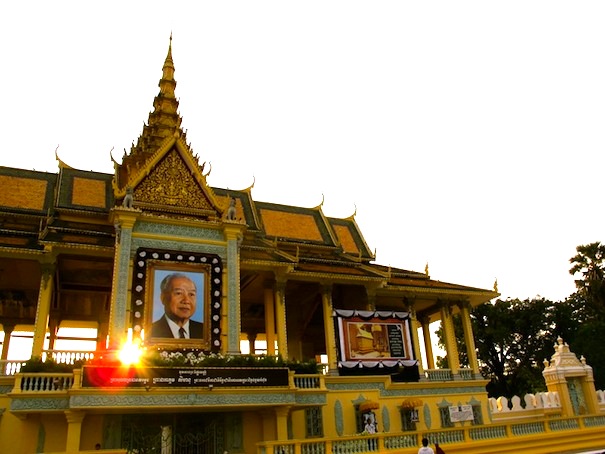

WEEKENDER – The body of former Cambodian King Norodom Sihanouk has been lying in state in Phnom Penh for the last two months. Now is your final chance to bid goodbye to one of the country’s greatest rulers and to experience a part of Cambodian culture unlikely to reemerge for decades to come.
Following a one-hour flight from Bangkok to Phnom Penh, it takes only another 20 minutes of driving to get from the airport to the century-old Royal Palace, or Preah Barum Reachea Veang Chaktomuk as it is known in Khmer. Cruising along Sothearos Boulevard, you will spot the Moonlight Pavilion (Preah Thineang Chan Chhaya) an open-air building that dominates the front of the Palace.
The golden-spired Moonlight Pavilion is now festooned with a giant portrait of King Sihanouk, who passed away from a heart attack at the age of 89 on Oct. 15, 2012 in Beijing. In front of the Pavilion, tables, tribute books, lotus flower jars and incense stick holders are set up for mourning Cambodians to perform Buddhist rituals and deliver written expressions to the deceased king.
Though the public is not allowed to enter the Throne Hall and step into the Preah Moha Monti, the room where Sihanouk’s body is exhibited, it’s still magnificent to observe how the Khmer people are remembering their King Father. If you arrive at 9:30am or 5:30pm, you may hear chanting sound from inside as monks hold their daily religious ceremonies.
Despite long periods of exile overseas and a 2004 abdication in favor of his son King Norodom Sihamoni, Sihanouk remained influential in the eyes of local people. Many grieving Cambodians are senior citizens who travel to the capital exclusively to show gratitude for the king. These mourners tend to view the king’s role in Cambodia’s independence from France in 1953 as his most remarkable feat.
Next to the palace’s high northern walls, craftsmen and architects are working on the pavilion and pyre where the body of King Norodom Sihanouk – eldest son of King Norodom Suramarit and Queen Kossamak – will be cremated on Feb. 4. The Ministry of the Royal Palace has taken charge of building a 10-meter-deep sheltered viewing area covering about 10,000 square meters inside Veal Preah Man park at a whopping USD5 million cost.
Heading toward the Palace’s southern end, you can drop in to learn more about Cambodian traditional architectural at a cost of USD6.50. Visitors are granted limited access to the palace grounds because of the King’s death; but you can still browse through the Silver Pagoda or Wat Preah Keo area, home to over a thousand antique Buddha statues and relics. Most famed of these relics is the Cambodian Emerald Buddha, a Baccarat Crystal statue carved in the 17th century.
Prior to the grand cremation, Sihanouk’s elaborate coffin will be removed from the royal residence on Feb. 1. A six-kilometer-long procession will take place through Phnom Penh, passing important and historical sites like Wat Phnom, Ounalom Pagoda, and the Independence Monument before ending at the funeral location, where the body will be kept until Feb. 4.
The procession date also marks the second period of mourning, from Feb. 1-7, when Sihanouk’s subjects will be seen in white shirts with black ribbons and black skirts or pants. Like the first weeklong period of mourning from Oct. 17-23, flags will be flown at half-mast.
King Sihanouk’s cremation will be an extraordinary opportunity for foreigners to observe ancient Khmer rituals in person, with about two million people expected to throng Phnom Penh’s streets along the procession route. After King Sihamoni and the Queen Mother light the funeral pyre, Sihanouk’s ashes will remain in a golden urn in a Royal Palace stupa. That is one of Sihanouk’s last wishes, as communicated in a royal letter last January.
As the ceremony draws near, Phnom Penh is getting more and more attractive as a cultural getaway. Your potential cultural lession will differ depending on when you choose to go. Visiting in February, you will comprehend the relationship between the monarch and his citizens. Elegant Khmer traditions, a massive amount of participants and a tearful atmosphere will also await you.
If you visit in January, you will experience the moment in a less formal way. Aside from the grieving associated with the passing of the King, you will also be able to get a glimpse of everyday Cambodian life. As pictured above, the park in front of the Royal Palace is a sight to behold, thanks not only to those who come to pay their last respects, but also to memorial portrait vendors, material offerings providers, and even the pigeon feeders. It would be worth the price of an airplane ticket solely to see the social interactions taking place in the Moonlight Pavilion, which stands distinctively against the riverfront skyline.
But regardless which choice you make, you need to act quickly because the cremation takes place in less than two weeks. The spectacles on view now in Cambodia will almost certainly not reappear during our lifetimes.
—
Sometimes you gotta get out of the city. Weekender is Coconuts Bangkok’s travel series on destinations that can be enjoyed on a weekend trip from Bangkok.