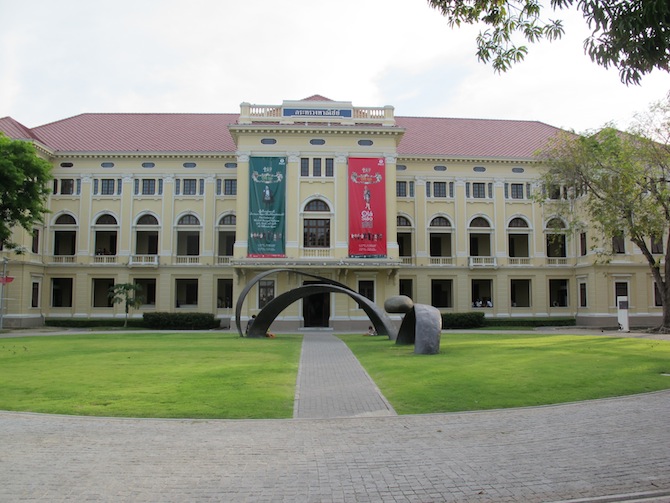

At a Museum Siam exhibition celebrating half a millennium of friendly relations between Thailand and Portugal, Thai visitors can learn more about their country from an unlikely source – a group of Portuguese historical figures who have reincarnated to describe their first steps into the kingdom of Ayutthaya.
“From 1494 the world was divided into two realms by Pope Alexander VI, the routes and lands in the East for occupation by Portugal and the West by Spain. That was the beginning of our relations with Siam,” says Alonso de Albuquerque, portrayed by an actor who, pointing his sword for emphasis.
The noted fidalgo, fully costumed, personally greets guests one-by-one at the exhibition titled: “Ola Siao – Five Centuries of Thai-Portuguese Relations: God, Greed and Gold – and the Ultimate Quest.”
In spite of aging almost 560 years, Albuquerque is standing fit and firm explaining how he helped increase Portugal’s influence over Southeast Asia by fortifying the growth of Portuguese economic power and a monopoly on trade.
“Focusing on the next route from India, I found Malacca the next destination for gold spices. But Malacca was part of the Pattani Kingdom, under Siamese colonial jurisdiction. Thus, I sent diplomats to the Royal Court of Ayutthaya to establish the relationship in 1511. And I recognized that you have such a powerful ruler,” the second Governor of the State of India elaborates, referring to King Ramathibodi II, who always warmly welcomed foreigners.
“Although Ayutthaya could not offer the spices we required, we never overlooked the kingdom. This was one of our most essential regional trade ports,” he admits.
Stepping inside the exhibition’s main room, history lovers get to meet seven other Portuguese characters who were significant to Thailand at the time. Dressed in traditional attire, actors and actresses take turn clarifying how the brought changes to the kingdom – politically, culturally, militarily and commercially.
After acquiring permission to trade with Ayutthaya, Portugal began piling up ivory, animal hides, rice and herbs in haste, reckoning that exotic spices and rare items from the East would bring them more riches than anything else. In turn, Portugal offered to sell pistols to Ayutthaya perhaps because it was known that Siam had frequent skirmishes and wars with neighboring countries.
“That was when we assisted Siam with a new war strategy. I taught the troops how to use weapons,” Domingos de Seixas says, recalling the experience of giving service to the Siamese army for almost 25 years.
Seixas reports that before the arrival of Portugal, Ayutthaya had utilized traditional approaches to war, with each army confronting the other on the battle field. Portugal showed the Siamese how firearms, ammunition, canons and brick fortresses could improve their military might.
“King Chairachathirat was benevolent. After serving as mercenaries in the Chiang Kran combat against Burma in 1545, we were given a crucial prize – the allocation of land and consent to build houses and Christian churches – as a token of his gratitude to our remarkable performance,” Seixas proudly concludes.
Following their settlement, it was the time for religious and cultural exchange. During the Ayutthaya period, there were three Catholic denominations with a presence in Siam including the Dominicans, the Jesuits of San Paolo and the Franciscans. Nevertheless, evangelism did not succeed owing to disputes and internal conflicts within the Church itself. Even though Siamese people had freedom to choose any religion, it was not usually easy for them to relinquish the religion of their ancestors.
Contrary to Portugal’s efforts to expand Catholicism, the cultures of the two countries slowly but surely mingled. Marie Guimar de Pinha, as widely known as Thao Thong Kip Ma in Thai, was one of the most well-known Portuguese who have influence over Thai civilization.
“I was born here in the Portuguese village”, Guimar recounts, holding a plate of Foi Thong or Golden Threads, which she created from her own original recipe of Fios de ovos. The dessert has been now listed as one of Thailand’s must-try sweet treats.
Lifting the dish up, she insists that all museum-goers stay until the end of the exhibition to taste several rare Portuguese food and beverages, proving her point that this is truly is a new style of exhibition in Thailand. Participants can listen, chat, smell, look and taste.
“During my term as head of the royal kitchen, I have made so many friends. Ayutthaya was truly a state of freedom where everyone had the right to choose their own job, and most importantly, there were numerous residents with mixed blood like me,” mentioned the woman of mixed Japanese-Portuguese ancestry, who later on was married to Chao Phraya Vichayen or Constantine Phaulkon, King Narai’s prominent prime minister.
This exhibition is a unique event with presentations and tangible tools, helping museum visitors learn more about the 500-year relationship between Thailand and Portugal – the longest relationship that Thailand has had with a Western nation.
“Nowadays, Thailand is the only Asian country that celebrates our mutual enduring history. And you can observe that my descendants have been living harmoniously with Thai people here in Bangkok,” the reborn Guimar says of the communities built around the Conception Church, Santa Cruz Church and Holy Rosary Church.
For Coconuts readers, if you are fond of history yet hate reading books, this is the exact exhibition for you. The Ola Siao – Five Centuries of Thai-Portuguese Relations exhibition, Thailand’s first live exhibition, compared to other museums in range, will be open from now to April 29th, daily 10 am to 6 pm, except Monday.
You can enjoy this summer treat for free at Museum Siam on Sanam Chai Road, Phra Nakhon District. Surf for more information at www.museumsiam.com or contact 02-225-2777 ext. 407.
The clip below is Albuquerque’s personal invitation.