
The most impressive announcement from the 16th Convention on International Trade in Endangered Species (CITES) conference might have come during the meeting’s first half-hour. During her opening statements to the conference’s 178 delegations, Prime Minister Yingluck Shinawatra pledged to put an end to Thailand’s controversial ivory trade, answering a call from the international wildlife community that had grown increasingly strident in the lead up to the meeting.
A press release from the World Wildlife Fund (WWF) quoted the PM as saying, “As a next step we will forward amending the national legislation with the goal of putting an end on ivory trade and to be in line with international norms.”
What that syntaxically challenging pronouncement amounts to is a commitment to break an essential linkage in the worldwide chain of ivory poachers, dealers and consumers that has, in recent years, threatened wild elephants with extinction.
At the moment, conservationists suspect that Thailand’s elephant population has shrunk to as low as seven or eight thousand animals, more than half of which are domesticated. African elephants, though further from extinction than their Asian counterparts, have undergone a 60% decline in population over the past decade.
Following Yingluck’s announcement, environmentalists reacted with equal measures of enthusiasm and reserve. Philip Mainsbridge, chief executive of the environmental charity Care for the Wild, summarized the NGOs’ cautious optimism while in conversation with the BBC: “While it is positive that the host country has recognized the size of the ivory issue and the importance of it,” he said, “we were disappointed by the lack of a clear commitment to banning the domestic trade.”
Mainsbridge, and others of his compatriots, pointed not to what Yingluck said, but to what remained absent from her speech – clear policy initiatives and a measurable timeline.
Though Yingluck has committed her government to taking action against the Thai ivory trade, that initiative hinges on several of the ineluctable realities of Thai politics, including a propensity for infighting and an infamously sluggish bureaucracy. Those same inefficiencies are responsible, in part, for the role the Kingdom currently plays in the ivory black market.
Thailand remains a hub for the worldwide ivory trade, owing primarily to a law that allows for the sale of ivory harvested from domesticated, Thai elephants. While this law stipulates that ivory sold in Thailand must come from an animal that has either died naturally or not been harmed in the collection process, it also leaves a grey area wide open for exploitation.
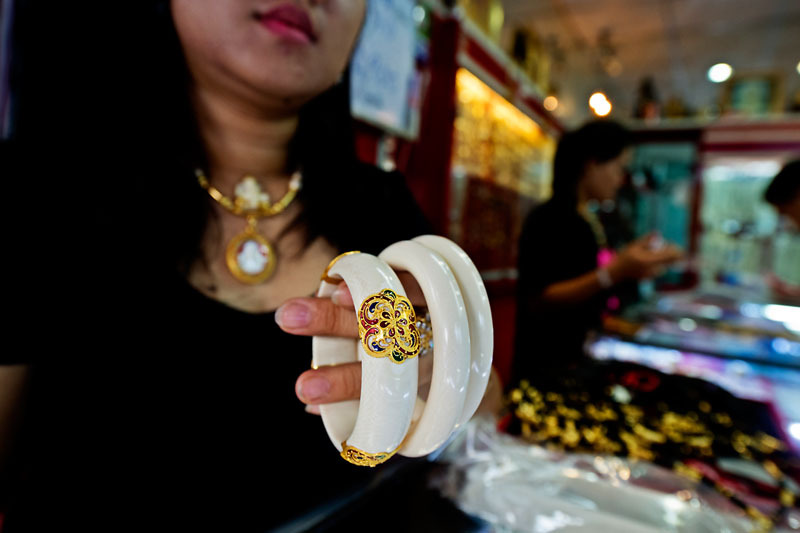
Both environmental activists and government officials hold the belief that large amounts of African ivory are “laundered” through Thailand’s laxly monitored system. Poachers in Africa kill elephants for their ivory, then smuggle the tusks to Thailand, where they are retailed through any one of the country’s 5,000 registered dealers. Stop by Chatuchak Market on any given weekend and you will find ivory earrings, bangles and amulets being traded in the open.
Though China comprises a large part of the worldwide market for ivory, many Thai nationals and tourists to the Kingdom consume it as well, helping to drive the worldwide trade.
The WWF has pursued a campaign over the past two months, calling on the PM to reform Thailand’s ivory laws, thereby making poaching within and without the Kingdom a less-profitable prospect. More than one million signatories to the WWF’s petition, as well as a PR push from Leonardo DiCaprio, helped press the Thai government to action.
Yingluck’s announcement comes as welcome news to many environmental organizations, but their tepid celebrations serve as a reminder that real-world solutions remain a long ways off.
“In reality, amending national legislation can take up to years to be realized,” says Siwaporn Jiab Tee, of the environmental NGO Freeland, in an email. “But the related government agencies can make it happen faster.”
Thailand’s elephant bureaucracy, like most bureaucracies in the country, is vast, tortuous and capable of defeating even the best-conceived plans.
While the Department of National Parks, Wildlife and Plant Conservation is charged with the prevention of elephant poaching in the wild, the management of the country’s domesticated elephant population falls under the auspices a different organization entirely – the Ministry of the Interior. The Customs Department, on the other hand, deals with ivory that traffickers try to sneak into or out of the country. Once poachers (or breeders) have removed ivory from a dead elephant, that ivory stands suddenly in the stead of the Department of Agriculture.
If any of these ministries wish to prosecute illegal ivory traders, they must enlist the help of Thailand’s law enforcement organizations.
Without a clear objective or a designated timeline, coordinating these ministries toward the common goal of curtailing Thailand’s ivory trade will remain a matter of pure speculation.
“Once the timeline has been put up, then it will be easier for us to work with the relevant ministries,” says Janpai Ongsiriwittaya, Wildlife Trade Campaign Manager for the WWF. “Without that common goal, it’s a very difficult problem.”
Janpai says that if Yingluck makes good on her promise, which Janpai believes she will, a decree will likely come from either the Ministry of Commerce or the Cabinet, demanding controls be put in place to stop the sale of ivory.
But, once again, Thailand’s bureaucracy could threaten any such initiatives. According to representatives from Freeland, Thailand has spent the past eight years trying to amend the Wildlife Conservation Act without anything in the way of measureable results. NGO workers specializing in ivory worry that Yingluck’s most recent promise could face a similar fate.
Then, there’s also the fact that any long-term attempt to curtail the trade hinges on the cooperation not only of the Thai government, but also the Thai people.
“I’m sure the Thai people still love elephants a lot,” says Ua-phan Chamnan-ua of WWF Thailand, “but because they still see elephants around, either in the elephant camps, or in the TV, in the print ads, whatever, they think that we still have a lot of elephants, that our elephants are still safe.”
In this case, lack of knowledge has manifest as lack of political will, allowing a nation whose character is linked inextricably with the elephant to serve as one of the chief instruments in that creature’s demise.
Whether Yingluck’s promise of political action constitutes a last-minute reprieve for Thailand’s elephants hinges on whether or not the country’s stakeholders can turn her words into a reality.