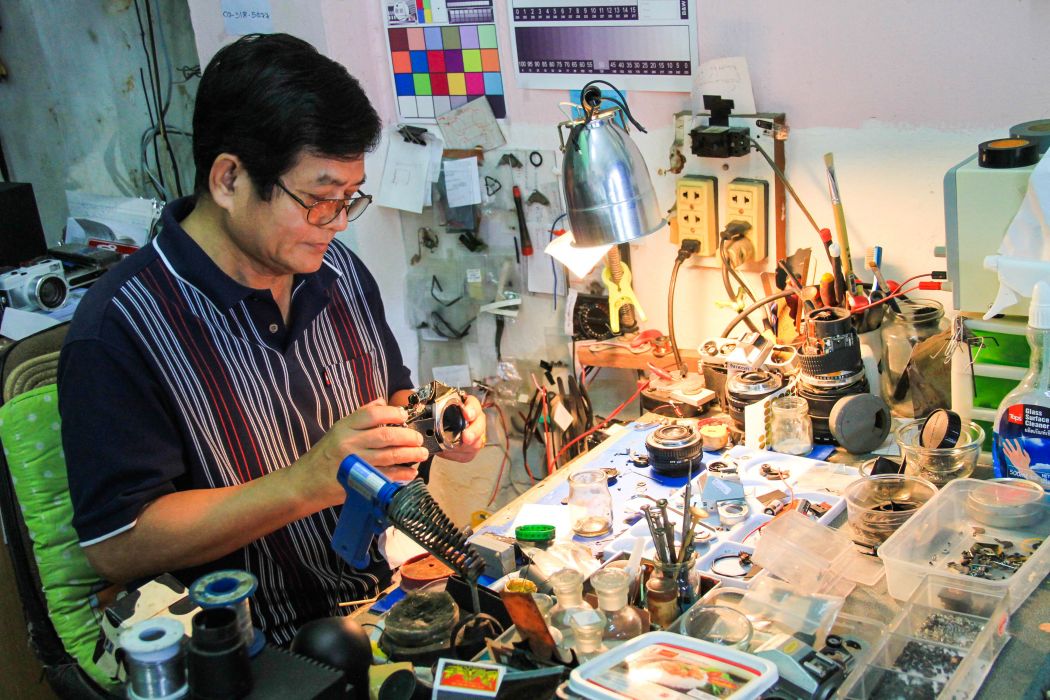

A dying art is alive and well inside Vimon Chabangam’s analog soul.
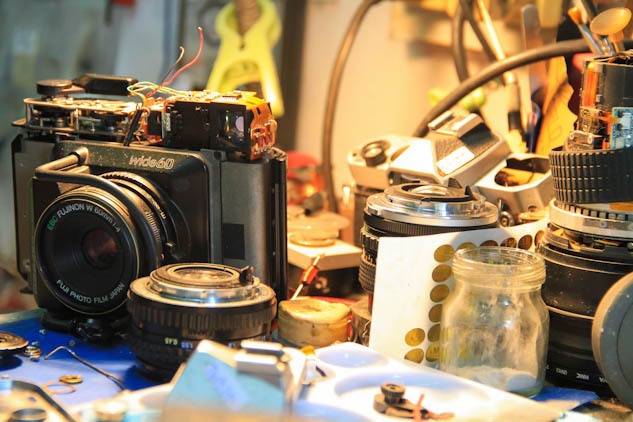
While most people have gone digital or shoot with smartphones, Vimon is one of those remaining, ardent sorcerers of the silver halides who also keeps the craft alive for others when something breaks.
For a pretty ordinary guy who toils away in his messy workspace, Vimon is something of a legend among the camera geeks and free-spirited film photographers he saves from desperation when their equipment goes bad.
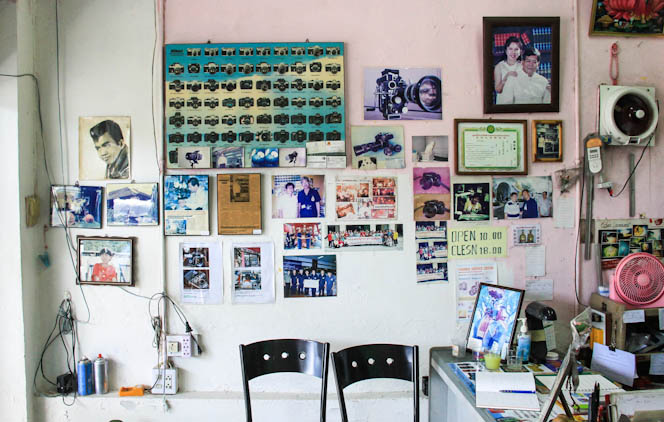
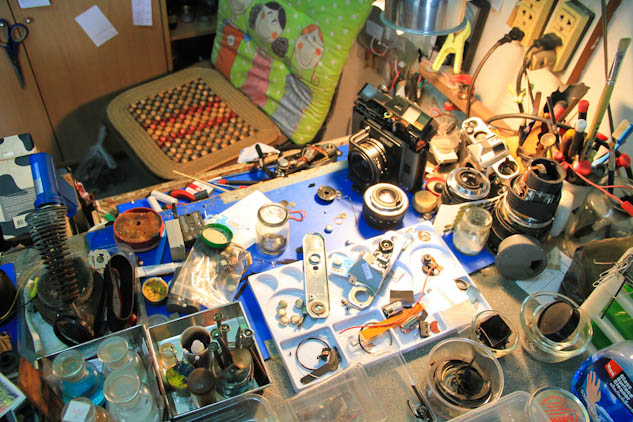
To understand what makes his love for vintage photography click, we found the 65-year-old photographer and camera tech among a clutter of miniature mechanisms and tools at one of his Vimon Camera shops.
CB: How did you come up with this career?
VC: Well, it all started during the Vietnamese-American War. I was born in Nakhon Sawan, and cameras were not a common thing in Thailand at that time. However, I had a chance to learn about cameras from the U.S. soldiers, GIs and other experienced people.
I started my first career as a photographer in 1960 and had traveled to many provinces including Udon Thani, Chonburi and later Bangkok. Spending most of my time in camera stores, I had gradually learned how to fix cameras. I collected some money and finally opened my own store in front of Royal Thai Army Radio and television Channel 5.
When moving the store to Saphan Kwai, I started to expand the branches and also began a camera repair school where the tuition fee was THB7,000 per person. My first group of students were 10 people.
CB: Is there any difference between fixing film cameras and digital cameras? How?
VC: Yes. Film cameras are much easier to fix since almost all my life has been with them.
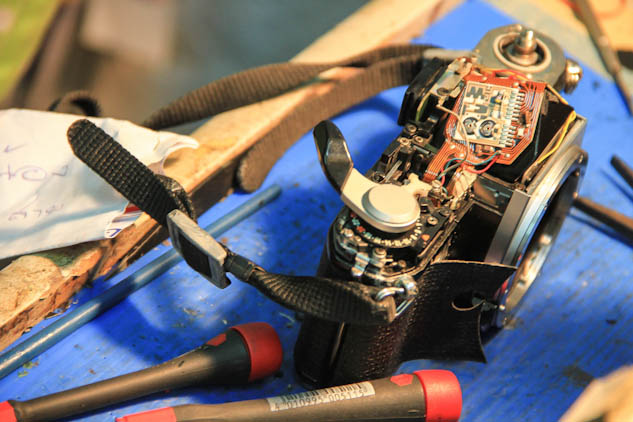
The most important thing in fixing film cameras is the mechanism, so it’s easy for me to do my job since I’m familiar with the functions and know how they work. But for digital cameras, it involves electricity, which can be tricky sometimes. Plus, it’s hard to find the right unique spare parts, both in brands and types.
CB: Besides repairing cameras, had you consider anything else?
VC: I would have ended up as an electrician. I used to ask an electrician guy to teach me about his career, but he refused when he knew I was already a camera technician.
“Do your best at what you’re doing,” he said. “Whatever it is, go for it.”
So I did my best in the photography field. I even made studio lighting umbrellas and other photography equipment for sale and succeeded well with that. So the guy was right about focusing on only one thing and trying my best. Jumping from one thing to the next is a waste of time.
CB: Why do you think customers keep seeking you out?
VC: My service-mindedness and honesty, I believe. I always explain to each client what’s wrong with their cameras. If the cost is too high, I would tell them frankly to buy a new one instead. I’m honest with my clients; no cheating. Clients who live far away and are unable to drop by themselves usually ship their cameras to me.
CB: What is the most enjoyable part of being a camera technician?
VC: The most entertaining part is when I realize that I still have got a lot more to learn. There is never really an end of learning as a camera technician. Over the years I learned more and more and it’s very fun.
CB: And what is most challenging?
VC: The most challenging part is the details of each camera. I need to go through each one carefully. Only one mistake would cause the whole camera not to work properly or even get totally messed up.
CB: What should a good picture look like in your opinion?
VC: A good picture is the one closest to what the eyes see. If your eyes see a reflection, then the picture should naturally show the reflection too. Flash therefore is hardly needed when taking a picture in daylight.
CB: Is there any photo you’ve taken and been most proud of?
VC: A fire at the Merry King shopping mall at Saphan Kwai in 1986. I captured it at the right angle, at the right place and at the right time.
CB: How do you see film photography these days? Will people still be interested in it?
VC: I think people will still use film cameras for years from now since its mysterious charm never fades away. Shooting film is very challenging because it needs more technique than digital cameras. At a minimum, the photographers need to know ISO, aperture and shutter speed. When the pictures come out how you expect, you’re proud. One of the great benefits of using film is that digital cameras cannot compete with its resolution. Even smartphones will never be as good as film cameras when talking about resolution.
CB: Whom would you like to pass on the skills to?
VC: I have passed on the skills to many people including my children. Four of them are at the other branches in Bangkok and run the sites for me including our Facebook page. My friend disagreed when I passed on these skills to my subordinates and students. They said I was stupid to share a part of my life to others. However, I think differently. One of my students who is a disabled man with polio opened a store and expanded the branches in many provinces in the northern part such as Phitsanulok, Lampang, Chiang Mai and Chiang Rai. He named the stores after me, “Vimon.”
Vimon Chabangam’s can usually be found at his Soi Sukhumvit 45 shop, but he has four other shops throughout Bangkok.