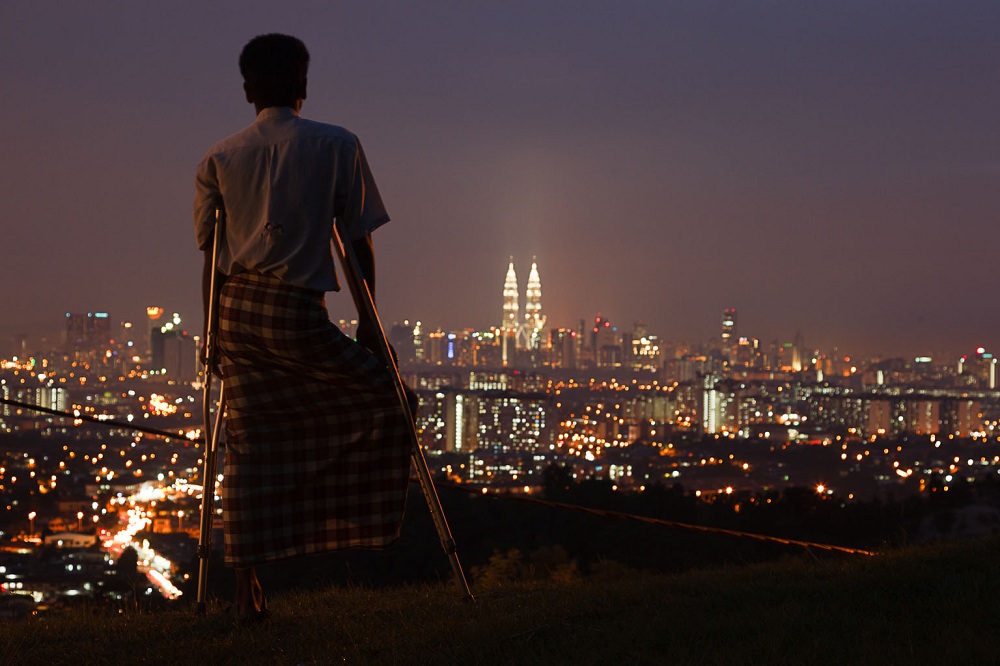

Suthep Kritsanavarin’s photography is not about the beauty, the composition or the art. It’s about the message, he says. It’s about giving voice to people struggling to be heard.
Stateless Rohingya: Running on Empty, Suthep’s latest project, is the result of a three-year endeavor to document the plight of one of the world’s most oppressed people and is now on display at the Foreign Correspondents’ Club of Thailand (FCCT).
The exhibit features a collection of photographs offering a rare glimpse into the lives of the Rohingya, an ethnic and religious minority in Burma (Myanmar), who are denied citizenship, education, jobs, freedom of movement, and myriad basic human rights within their home country.
Suthep not only photographed Rohingya in Burma, but followed the well-worn “escape routes” many have taken to flee the horrors of daily life in a homeland that rejects them.
“I spent over three years in Burma, Bangladesh, Thailand, Malaysia, Indonesia and Australia [photographing Rohingya refugees],” he said.
“I saw in the news, like everybody else, around 2007 – I saw the Rohingya coming to southern Thailand, the boat people, and I had to question myself why and how. Why did these people have to come here like this?
“So, I started to explore and research more and later met with some people knowledgeable about the situation and decided we should do this and give [the Rohingya] attention.
“For me, photography is just a tool to give a visual message–to show what’s happening. So, every time I choose a subject, I choose it because I feel I should give it a voice. This time it’s the Rohingya because I think they are one of the most persecuted and marginalized people in the world. No one cares about them. They don’t have identification cards, they don’t have any status in any way in the world–not even in their homeland,” Suthep said.
There are roughly 1,000 Rohingya who have been resettled in third countries like the United States, Canada, Australia and in Europe after making the risky escape to neighboring lands, but this is but a tiny fraction of the three million or so who remain stateless, he added.
Suthep said his goal with the exhibit is to educate local people in neighboring countries, such as Thailand, about the difficulties facing the Rohingya in an effort to create pressure on governments and NGOs to try and “work something out.”
“I think if they really apply pressure, if Asean applies pressure, they can change the situation–In the long-term, of course. For the Rohingya now, there is zero short-term solution.
“If I do anything at the moment – and this is just me – photography, as I said, is a tool to bring a message to other people. The meaning of photography at the beginning is the issue, to document and give a message.
“This is why I take photos. Not for the art actually. I think a good photo itself is nothing because, okay, you have a powerful eye, you have a good photographer–but what are you doing with that [talent]? The effect of the image is more important than its quality. It’s the whole story, not just one photo. This is the most important thing for me, not just to publish my work, but to educate people so they understand what’s happening–why and how,” Suthep said.
Suthep, who has won international awards for his in-depth photographic documentaries, cautions that “hot news” is not the answer, but long-term, sustained work is key to effecting change. His current month-long exhibition was launched at the FCCT on May 18.
To view photographs from his previous projects, which include documentaries of the lives of Thailand’s Kuay mahouts and their elephants, life along the Mekong River and the aftermath of Cyclone Nargis (where he had to disguise himself as a Karen villager to avoid detection), visit suthepphoto.com.
As for his next project, Suthep remains tight-lipped: “I have something in mind, but haven’t planned it yet.”










